The DZOMUSA – 7th Design and Development of Zero-Emissions Off-Highway Machinery Summit took place from 10–11 December, bringing together attendees from across the zero-emission off-highway machinery industry at the Holiday Inn Louisville East – Hurstbourne. The two-day conference offered a wide and comprehensive agenda, featuring dozens of presentations from expert speakers, panel discussions, and networking breaks.
Our attendees explored challenges and opportunities in developing new technologies, with a particular emphasis on the latest breakthroughs in electric, hybrid, and alternative powertrains, as well as drive integration and energy management, while also examining the wider sustainability impact on the industry.
This article will provide a session recap for those who didn’t get the chance to attend and serve as a reminder for those who attended.
Large Ag Biofuel Solutions
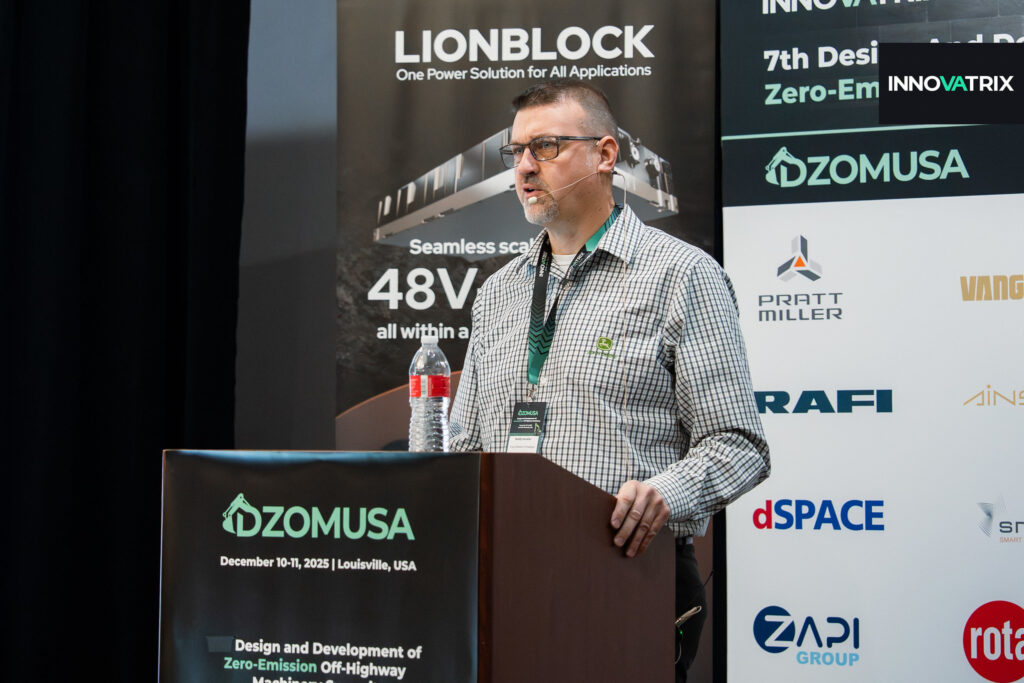
Harold (Buddy) Kavalier, Engine Research Strategist at John Deere Power Systems

Buddy discussed the role of biofuel solutions in reducing emissions from large agricultural machinery, highlighting the significant progress made in cutting particulate matter and NOx emissions since the late 1990s. He explained that large tractors and combines operate under demanding conditions with high energy requirements, making them difficult to electrify and reinforcing the need for practical low-carbon fuel alternatives.
The presentation focused on improving engine efficiency and evaluating renewable fuels, including renewable diesel, biodiesel and high-blend ethanol. Buddy noted that renewable diesel production remains relatively small compared with overall diesel demand in the United States, with supply concentrated in regions supported by low-carbon fuel policies.
A key area of interest is E98 ethanol, which offers lower lifecycle greenhouse gas emissions and can be considerably less expensive than fossil diesel on an energy-adjusted basis. Advances in combustion, control and injection systems have improved ethanol’s viability for large agricultural applications while enabling simplified aftertreatment systems.
Buddy also addressed the challenges associated with ethanol adoption, including lower energy density, fuelling infrastructure requirements, cold-start performance, durability considerations and engine modifications. Despite these challenges, the aim is to deliver diesel-like performance with superior emissions performance across large agricultural equipment.
Fully Electrified Heavy Machinery for the Nut Industry
Tyler Hupp, Product Development Manager at Flory Industries

Tyler outlined the development of fully electrified heavy machinery for the nut industry and the opportunities presented by advances in battery technology and electric powertrains. He highlighted the growing need for electrified agricultural equipment that can operate reliably in demanding environments while improving performance and reducing operating costs.
The presentation focused on the development of an electric elevator designed with a modular architecture to improve reliability, enhance operational safety and lower fuel and servicing costs compared with conventional diesel equipment. Alongside the product goals, Tyler emphasised the importance of building internal expertise in electric powertrain design and machine integration to support the wider transition towards electrification in agriculture.
Operational data from existing diesel machinery demonstrated significant idle time, highlighting the potential efficiency gains achievable through electrification. The electric model has been designed to provide a full day’s operation with consistent unloading performance and low battery consumption per cycle.
Tyler also addressed charging and infrastructure challenges, particularly in remote operating environments. A towable battery energy storage system was developed to provide multiple days of runtime and enable flexible charging arrangements.
Finally, he outlined a roadmap for future electrification and hybridisation projects across additional harvesting equipment, targeting improved efficiency and performance throughout the product range.
ePOP: Power Sizing for Off-Highway
Nathan Rues, Powertrain Optimization Engineer at ZeBeyond

Nathan explored the growing complexity of powertrain configuration and sizing for off-highway vehicles as the range of available power sources and technologies continues to expand. He highlighted the unique challenges faced by the sector, including lower production volumes, bespoke powertrain requirements, small engineering teams and highly specialised customer duty cycles.
The presentation emphasised that off-highway manufacturers must now evaluate a much broader solution space, considering battery-electric, hybrid and conventional architectures alongside different fuel options, cooling requirements and power delivery systems. This complexity creates a need for accessible tools that can rapidly assess technical and commercial trade-offs without requiring significant training or specialist IT support.
Nathan outlined the key requirements for an effective powertrain sizing solution, including system-level analysis, optimisation of initial and operating costs, consideration of size and weight constraints, and the ability to compare alternative architectures quickly and clearly. The ability to share results across manufacturers, suppliers and customers was also identified as an important factor in supporting informed decision-making.
He presented ePOP as a tool designed to address these challenges by providing intuitive and transparent powertrain analysis. Its system-based approach enables users to evaluate multiple configurations efficiently while restoring confidence and clarity to the powertrain development process for off-highway applications.
Fuel-SPOTTM: Enabling the Decarbonization of Existing and Future Combustion Engine Machines
Chris Bitsis, Assistant Director at the Southwest Research Institute (SwRI)

Chris examined how fuel-flexible technologies can support the decarbonisation of both existing and future combustion engines through the use of renewable and low-carbon fuels. He explained that different fuels affect engine performance and emissions in different ways, making fuel detection and adaptive engine calibration increasingly important.
The presentation introduced Fuel-SPOT, a technology that uses standard on-board engine sensors and advanced signal processing techniques to identify the fuel being used in real time. This enables engines to automatically optimise performance, efficiency and emissions across a wider range of fuels, including fuel blends, without requiring additional hardware.
Chris demonstrated how higher biodiesel blends can negatively impact engine torque, exhaust temperatures and NOx emissions when conventional calibrations are used. However, by adapting fuelling strategies and thermal management systems, engine performance and emissions can be brought back in line with baseline fuel performance.
Fuel-SPOT offers additional benefits beyond emissions reduction, including improved uptime, warranty protection, fuel traceability and support for carbon reporting and government incentive schemes. The technology also enables customers to take advantage of available low-carbon fuels while maintaining consistent torque, fuel economy and emissions performance.
Chris concluded that fuel-flexible engine technologies will play an important role in future-proofing combustion powertrains as the transition to lower-carbon fuels accelerates.
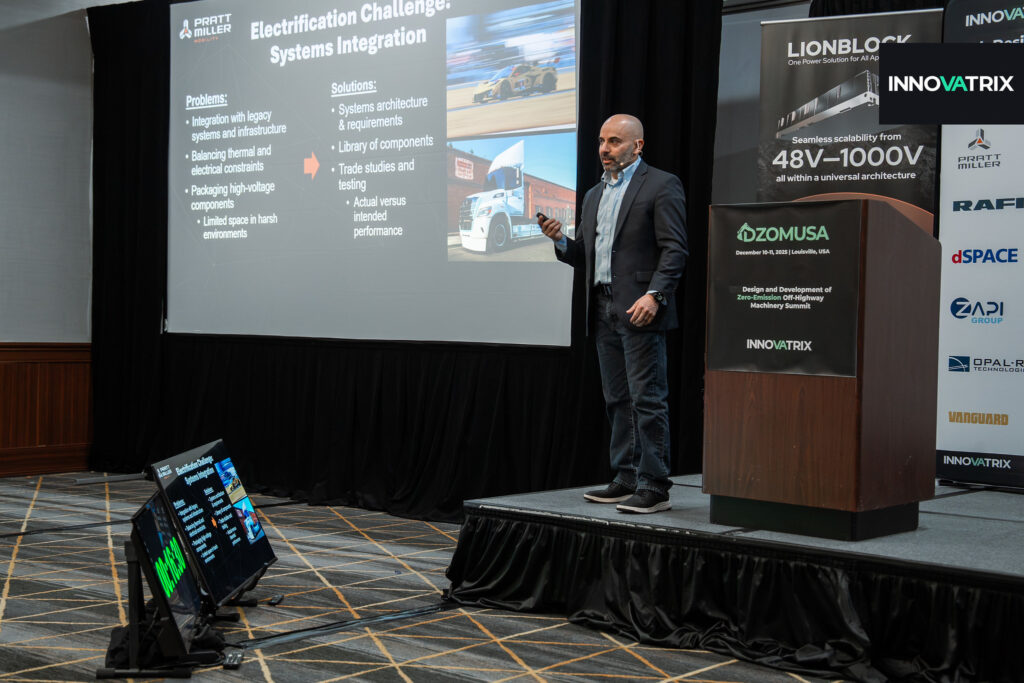
Leveraging Pratt Miller’s Commercial, Defense, and Motorsport Experience to Optimize Off-Highway Vehicle Electrification
Jon Honig, Vice President, Mobility at Pratt Miller

Jon explored the key challenges facing the electrification of off-highway vehicles and demonstrated how expertise from commercial, defence and motorsport sectors can accelerate the development of robust and scalable solutions. He highlighted that many of the obstacles encountered in off-highway applications are shared across industries, creating opportunities to transfer proven technologies and engineering practices.
The presentation focused on five major challenges: systems integration, rapidly evolving technologies, harsh operating conditions, safety and reliability, and the development of purpose-built vehicles. Jon explained that integrating high-voltage components into constrained vehicle architectures requires careful consideration of thermal management, packaging and legacy infrastructure. Modular system architectures, component libraries and rigorous testing can significantly reduce development risks.
He also addressed the fast-changing supplier landscape and evolving regulations, emphasising the importance of designing flexible platforms that can accommodate future technological developments. Vehicle modelling, simulation and robust control systems were presented as essential tools for ensuring performance in demanding environments.
Safety, reliability and maintainability remain critical considerations for electrified platforms, particularly in low-volume applications. Jon highlighted the value of component reuse and human-centred design in improving quality and reducing costs.
He concluded that successful off-highway electrification depends on developing flexible, rugged and validated systems that combine defence-grade durability, commercial-grade engineering rigour and motorsport-inspired development speed.
Barriers and Enablers to the Adoption of Electrification Technology in Mining
Andrew Elsen, Sr. Program Manager at Komatsu North America

Andrew examined the barriers and opportunities associated with adopting electrification technologies in the mining industry, highlighting that mining is responsible for approximately 4–7% of global greenhouse gas emissions, with mobile diesel-powered equipment contributing a significant proportion of these emissions. Surface mining haulage was identified as one of the most impactful areas for decarbonisation.
He outlined how underground mining has already demonstrated the viability of electrification through battery-powered haulage systems and trolley assist technologies, providing valuable lessons for surface mining applications. Battery-electric haul trucks are emerging as a promising solution, supported by rapid advances in battery technology and increasing energy density.
Andrew discussed the importance of charging infrastructure, including stationary and dynamic charging systems, noting that a combination of charging methods tailored to individual mine sites is likely to be required. He emphasised that future mining operations will demand substantial investments in grid infrastructure, on-site renewable energy generation and sophisticated energy and fleet management systems.
The presentation also explored key barriers to adoption, including high capital costs, skills shortages, regulatory uncertainty and a lack of industry standards. Andrew concluded that standardisation, automated high-power charging and multimode charging strategies will be essential to accelerating the successful electrification of surface mining operations.
Operations Aware Energy Management Strategy for Electrified Off-road Vehicle
Qadeer Ahmed, Director Mobility Systems Lab/Assistant Professor at The Ohio State University

Qadeer explored how intelligent energy management strategies can support the electrification of off-road vehicles, which account for approximately 10% of transportation sector emissions. He highlighted the unique challenges facing off-road applications, including demanding operating conditions, limited charging infrastructure, battery constraints and the need for high power and torque density.
Using agricultural tractors as a case study, Qadeer demonstrated the potential of series hybrid powertrain architectures to improve engine efficiency by enabling operation within optimal power zones. Given the highly variable operating environments of agricultural machinery, developing effective energy management systems remains a significant challenge.
The presentation outlined a simulation framework that incorporates terrain characteristics and real-world duty cycles to assess powertrain performance under varying conditions. Several control strategies were evaluated, including rule-based controls, dynamic programming and reinforcement learning approaches.
Particular attention was given to the use of Double Deep Q-Network (DDQN) reinforcement learning for managing power distribution between the engine and battery. The DDQN controller achieved fuel consumption reductions comparable to optimal benchmark models while demonstrating greater adaptability to previously unseen operating conditions. It also outperformed conventional rule-based strategies and proved more robust when handling variations in power demand.
Qadeer concluded that reinforcement learning offers a promising foundation for next-generation, real-time energy management systems for electrified off-road vehicles.
Powering Tomorrow: Developing a Scalable and Sustainable Battery Ecosystem for Off-Highway Fleets
Athan Tsokolas, Product Manager – Electrification at Briggs & Stratton (Vanguard)

Athan discussed the challenges and opportunities involved in building a scalable and sustainable battery ecosystem for off-highway fleets. He emphasised that the greatest obstacle to electrification is not technological feasibility, but the ability to scale solutions effectively across diverse applications.
The presentation highlighted the importance of modular battery design in delivering flexible power systems that can be standardised while remaining adaptable to different machine requirements. Athan noted that scalability depends on developing an ecosystem rather than simply replacing existing hardware with battery packs.
Charging infrastructure was presented as a logistical challenge rather than solely a technical one. He advocated for bringing power directly to machines through mobile energy storage and battery-swapping solutions, enabling faster and more practical fleet operations in remote or demanding environments.
Athan also explored the role of telematics and Internet of Things technologies in improving energy management, predictive maintenance and overall fleet efficiency. Finally, he addressed the importance of end-of-life responsibility for commercial-grade batteries, outlining how recycling and second-life applications can support a circular economy. By designing batteries with reuse and data-driven asset management in mind, organisations can improve sustainability while creating long-term commercial value across the electrification ecosystem.
California’s Efforts to Advance Zero Emission Technology in the Off-Road Sector
Matthew Diener, Air Pollution Specialist at the California Air Resources Board (CARB)

Matthew outlined California’s strategy to accelerate the adoption of zero-emission technologies across the off-road sector as part of its wider air quality and climate objectives. He highlighted that off-road equipment remains a significant contributor to nitrogen oxide and particulate matter emissions, disproportionately affecting low-income and disadvantaged communities.
The presentation reviewed existing and proposed regulations targeting off-road diesel fleets, forklifts, small off-road engines, transportation refrigeration units, cargo handling equipment, aviation ground operations and marine vessels. These measures are intended to encourage the transition from conventional diesel-powered equipment to cleaner and zero-emission alternatives.
Matthew explained that California is pursuing a combination of regulatory requirements, incentive programmes and infrastructure support to drive adoption. Proposed Tier 5 emission standards and advanced clean equipment regulations are designed to further reduce emissions from compression-ignition engines while increasing the availability of zero-emission equipment.
He also highlighted initiatives that provide funding and non-monetary incentives for cleaner technologies across construction and heavy-duty applications. Matthew concluded that zero-emission off-road equipment offers environmental and operational benefits, including reduced maintenance requirements, lower operating costs and improved equipment uptime, supporting California’s ambitious decarbonisation goals.
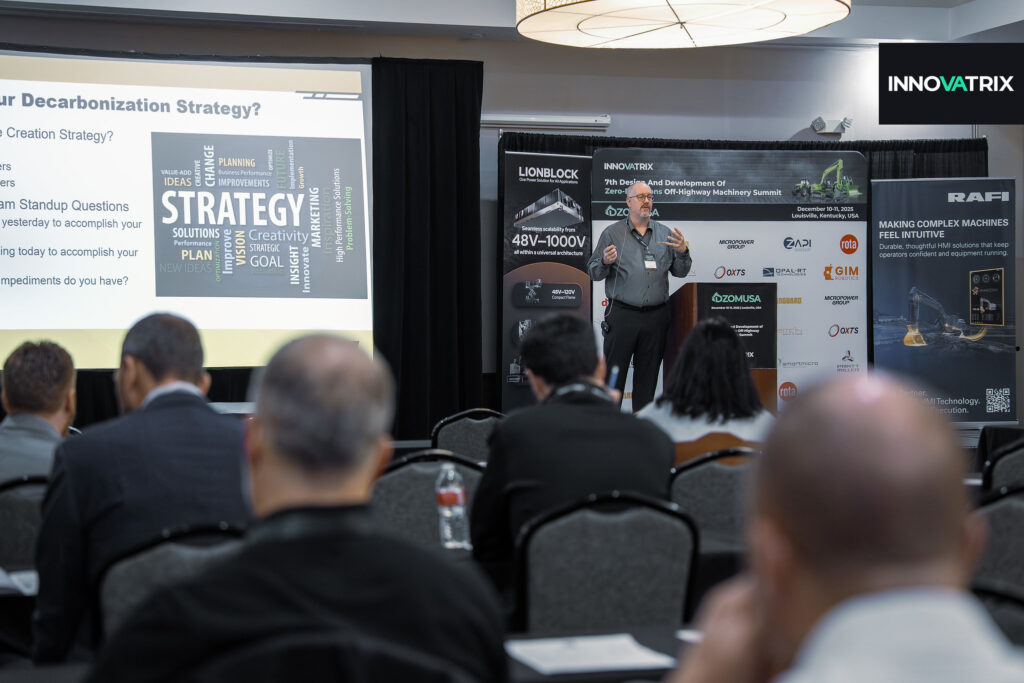
What Defines a Successful Decarbonization Project?
John Westman, Engineering and Technical Publications Manager at Pettibone

John explored the key principles that underpin successful decarbonisation projects, emphasising the importance of clearly defining objectives before development begins. He argued that establishing a well-defined strategy is essential for determining project scope, prioritising work and avoiding unnecessary complexity or delays.
The presentation highlighted the need to understand market demands and establish a clear definition of success from the outset. John encouraged organisations to identify their role within the decarbonisation landscape and align projects with broader business objectives and customer expectations.
A central theme was the adoption of the Minimum Viable Product (MVP) approach, which enables organisations to deliver value more quickly through iterative development. By focusing on essential features and incorporating end-user feedback throughout the process, businesses can reduce wasted effort and accelerate market introduction.
John also discussed the importance of agility, cross-functional collaboration and value creation in delivering successful projects. He outlined practical approaches to maintaining alignment within project teams, including regular progress discussions and the identification of obstacles that may hinder delivery.
He concluded by encouraging organisations to define their strategic priorities and focus on the next practical steps needed to achieve their decarbonisation goals.
Alternative Fuels to Consider for Off-Road Vehicles
Steve Duricky, Global Platform Manager at Parker Hannifin

Steve examined the alternative fuel options available for off-road vehicles and their role in supporting decarbonisation strategies. He highlighted hybrid electric systems as a practical solution that can reduce emissions, improve system efficiency and enable quieter operation while maintaining relatively small and affordable battery packs.
The presentation explored the potential of natural gas as an alternative fuel, including compressed natural gas (CNG), liquefied natural gas (LNG) and renewable biogas. Steve noted that natural gas technologies are already being used successfully in several heavy-duty mobile applications and can provide a pathway towards lower-carbon operations.
Hydrogen was presented as a key future fuel, with both hydrogen internal combustion engines and hydrogen fuel cell electric vehicles offering distinct advantages and technical considerations. He outlined the infrastructure and component requirements for hydrogen systems, including storage technologies, thermal management, pressure regulation, humidification and air filtration.
Steve also addressed the importance of industry standards and material selection when designing hydrogen-powered systems, particularly in preventing hydrogen embrittlement and ensuring safe operation. Standardisation and robust engineering practices will be critical as hydrogen technologies mature.
He concluded that alternative fuels offer multiple pathways for off-road vehicle decarbonisation, with ongoing advances in fuel systems and industry standards supporting their wider adoption.
Rethinking Battery System Design Strategies
Rob Thomson, Global Director – Construction Equipment at Micropower Group

Rob discussed how battery system design strategies for off-highway equipment must evolve to support large-scale electrification programmes. He highlighted the industry’s current reliance on off-the-shelf battery solutions and project-specific developments, arguing that a broader portfolio-based approach is needed to improve scalability and reduce complexity.
The presentation emphasised the value of establishing flexible and modular battery platforms built upon standardised battery modules, battery management systems and power control assemblies. These foundational building blocks can support a wide range of battery pack configurations and voltage requirements while minimising the need for extensive customisation across machine portfolios.
Rob outlined the importance of adopting a flexible battery architecture that balances tailored pack designs with standardised compliance requirements. Taking a portfolio-wide view allows manufacturers to identify common requirements across different machine types and develop more efficient electrification roadmaps.
Supply chain resilience was identified as a critical consideration, particularly given geopolitical factors, evolving battery cell technologies and emerging regulatory requirements. Maintaining flexibility in cell sourcing and engaging closely with battery suppliers and other key component manufacturers can help mitigate future risks.
Rob concluded that successful battery system design depends on modularity, strategic partnerships and long-term planning. By aligning machine portfolio requirements and minimising unnecessary customisation, manufacturers can create scalable and adaptable electrification solutions for off-highway applications.
Powering Progress: Lessons from 20 years of electrification at Deere
Will Cross, Electrification Engineering Manager – Architecture, Systems, & Controls at Deere & Company

Will reflected on two decades of experience in off-highway vehicle electrification, highlighting how manufacturers can identify where electrification delivers the greatest value across different applications. He emphasised that successful electrification strategies extend beyond achieving zero emissions and should consider broader operational and technological benefits.
The presentation outlined an architectural spectrum ranging from generated electric systems and mild hybrids to plug-in hybrids and fully battery-electric vehicles. Will explained that selecting the appropriate architecture depends on the specific requirements of the application and the value it delivers to customers.
Key value drivers discussed included lower operating costs, improved performance and reliability, reduced noise levels, easier machine operation and the ability to enable emerging technologies. Electrification was also presented as an important enabler for advancements in controls, autonomy and energy management systems.
Will highlighted the role of common electrical architectures in creating scalable solutions across multiple machine platforms. Standardised approaches allow manufacturers to leverage shared technologies while accommodating differing operational requirements. Examples such as electric variable transmissions demonstrated how electrification can improve efficiency, provide more precise power delivery and enable additional capabilities.
He concluded that the future of off-highway electrification lies in strategically applying the right technologies to the right applications while building flexible architectures that support continued innovation across machines, autonomy and energy infrastructure.
Excavator Powered by Hydrogen Combustion Engine: Hydraulic Actuation and Engine Interaction
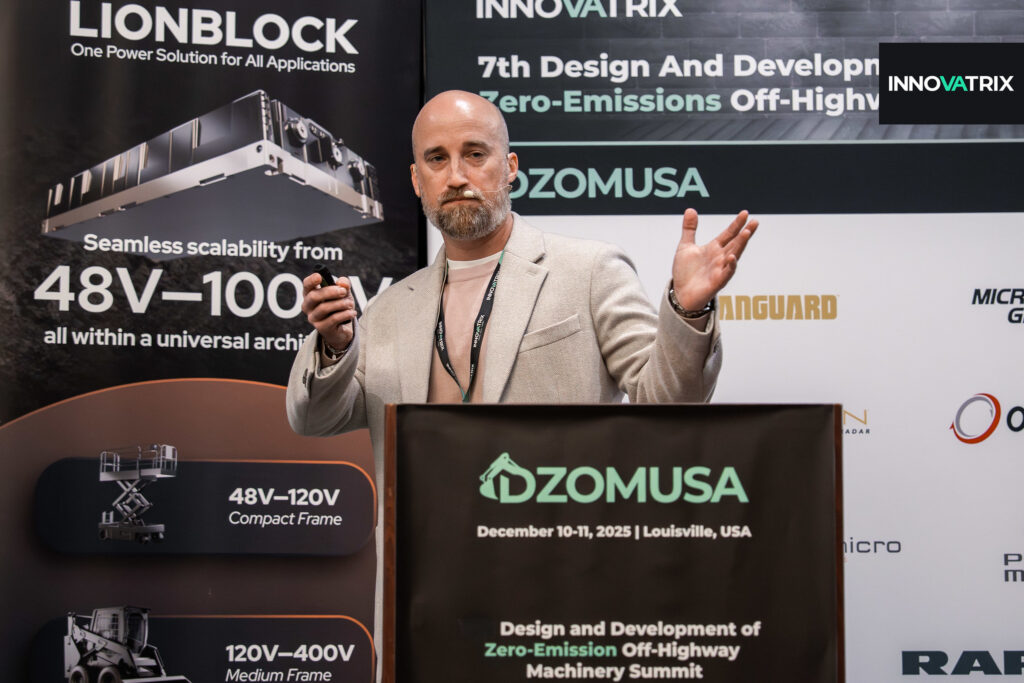
Andrea Vacca, Maha Fluid Power Faculty Chair at Purdue University

Andrea examined the potential of hydrogen combustion engines as a decarbonisation pathway for off-road vehicles, using an excavator application to demonstrate the interaction between hydraulic actuation systems and engine performance. He argued that achieving carbon neutrality will require a combination of technologies rather than reliance on a single solution, owing to infrastructure, supply chain and customer adoption challenges.
The presentation compared hydrogen combustion engines with fuel cell technologies, highlighting the advantages of hydrogen internal combustion engines in large vehicles operating in harsh environments. Factors such as total cost of ownership, existing infrastructure, job security and geopolitical considerations were also identified as drivers for their adoption.
Andrea discussed the technical challenges associated with hydrogen combustion engines, particularly their limited torque response and lower energy efficiency compared with diesel engines. These limitations can make their deployment in demanding off-road applications difficult.
To address these issues, he presented a hybrid hydraulic actuation system based on multi-pressure rail technology combined with engine e-boosting and advanced control strategies. Simulation results demonstrated improvements in hydraulic efficiency and significant reductions in NOx emissions while maintaining acceptable engine performance.
Andrea concluded that hydrogen combustion engines can play an important role within a mixed decarbonisation strategy for off-road vehicles, particularly when paired with innovative hydraulic and engine management technologies that enhance efficiency and operational performance.
Read the “Fantastic” Manual – Removing Secondary Cognitive Barriers to Technology Adoption
Ashley York, Global Technical Communication Manager at Manitou Group

Ashley explored the psychological and cognitive factors that influence the adoption of emerging technologies, particularly green technologies. She highlighted that public concerns around infrastructure, unexpected problems and costs create significant barriers to acceptance, even before users interact with the technology itself.
The presentation focused on the concept of secondary cognitive barriers, such as unintuitive interfaces, unnecessary complexity and ineffective documentation, which can negatively affect user confidence and satisfaction. Ashley explained that uncertainty reduces engagement and increases information-seeking behaviour, making clear communication and thoughtful design essential for successful technology adoption.
Drawing on psychological theories and cognitive biases, she demonstrated how poor user experiences can reinforce negative perceptions and discourage adoption. Strategies to address these challenges include reducing complexity, avoiding unclear choices, minimising inconveniences and designing products that provide meaningful value to users.
Ashley emphasised that seemingly minor design decisions can have a disproportionate impact on public perception and user satisfaction. She concluded that while technical performance remains important, effective communication, intuitive design and an understanding of human behaviour are equally critical in accelerating the successful adoption of new technologies.
Off-Highway Electrification – Duty Cycle Challenges & Battery Sizing
Suprith Jagannath, Sr. Technical Project Manager – HV Battery Module at Lucid Motors

Suprith examined the critical role of duty cycle data in the electrification of off-highway machinery and its impact on high-voltage battery sizing, system design and total cost of ownership. He highlighted that accurately characterising machine operating patterns is fundamental to developing efficient and commercially viable electrified powertrains.
The presentation explored how off-highway duty cycles differ significantly from on-road applications, owing to intermittent peak loads, mixed stationary and locomotion operations, variable workloads and high hydraulic power demands. These factors have a direct influence on battery sizing, cooling requirements, charging strategies and battery degradation over time.
Suprith identified several challenges relating to duty cycle data, including a lack of industry standardisation, limited access to proprietary field data and the scarcity of high-resolution datasets. He emphasised the importance of collecting representative operational data early in the development process and validating synthetic duty cycles through simulation and prototype testing.
The presentation also addressed the trade-offs between battery size, cost, machine performance and operational flexibility. Hybrid architectures, modular battery systems and alternative charging approaches were highlighted as practical solutions for demanding applications.
Suprith concluded that duty cycle-driven design is essential for scalable off-highway electrification. Greater collaboration, standardised data protocols and investment in simulation and field validation will be key to accelerating the adoption of electrified off-road machinery.
Alamo Group introduction – Our electrification journey
Brian Giles, Product Development Manager at Alamo Group

Brian shared lessons learned from Alamo Group’s electrification journey, highlighting that transitioning off-highway equipment from conventional powertrains to electric and hybrid systems involves far more than replacing internal combustion engines and hydraulic components. He emphasised that electrification presents technical, organisational and operational challenges throughout the product lifecycle.
The presentation explored the complexities of working with suppliers and technology partners, noting that commercial solutions may not always be production-ready or fully validated for specific applications. Brian described the importance of engaging genuine subject-matter experts and maintaining close collaboration with component manufacturers to resolve technical issues and adapt systems for real-world requirements.
He also discussed the challenges associated with bringing electrified products into production. Manufacturing facilities must implement new assembly processes, high-voltage safety procedures and comprehensive workforce training programmes. Electrified vehicles introduce additional considerations such as high-voltage interlocks, specialised software and revised start-up and shutdown procedures that differ significantly from traditional equipment.
After-sales support was identified as another critical area requiring investment. Service technicians must develop new diagnostic skills and become familiar with high-voltage systems, proprietary diagnostic tools and electric powertrain components.
Brian concluded that successful electrification requires a holistic approach encompassing product development, supplier management, manufacturing, safety, workforce training and long-term service support. Electrification is as much an organisational transformation as it is a technological one.
Sponsors
The DZOMUSA – 7th Design And Development Of Zero-Emissions Off-Highway Machinery Summit was supported by a wide range of sponsors who brought their teams to our exhibition hall, and Innovatrix would like to thank them again for their support.
Pratt Miller, Vanguard by Briggs & Stratton, Micropower Group, ZAPI Group, ZeBeyond, Rota Limited, and RAFI.
If you want to attend our next zero-emissions off-highway summit and have the opportunity to hear presentations like these and many more, join us for our American edition next year, taking place Q1 in Chicago. To discover the latest innovations and trends in electric, hybrid and alternative powertrains in off-highway machines, meet with solution providers and hear talks from industry leaders, register for the 8th Design And Development Of Zero-Emissions Off-Highway Machinery Summit!
For more information, visit our website or email us at info@innovatrix.eu for the event agenda. Visit our LinkedIn to stay up to date on our latest speaker announcements and event news.