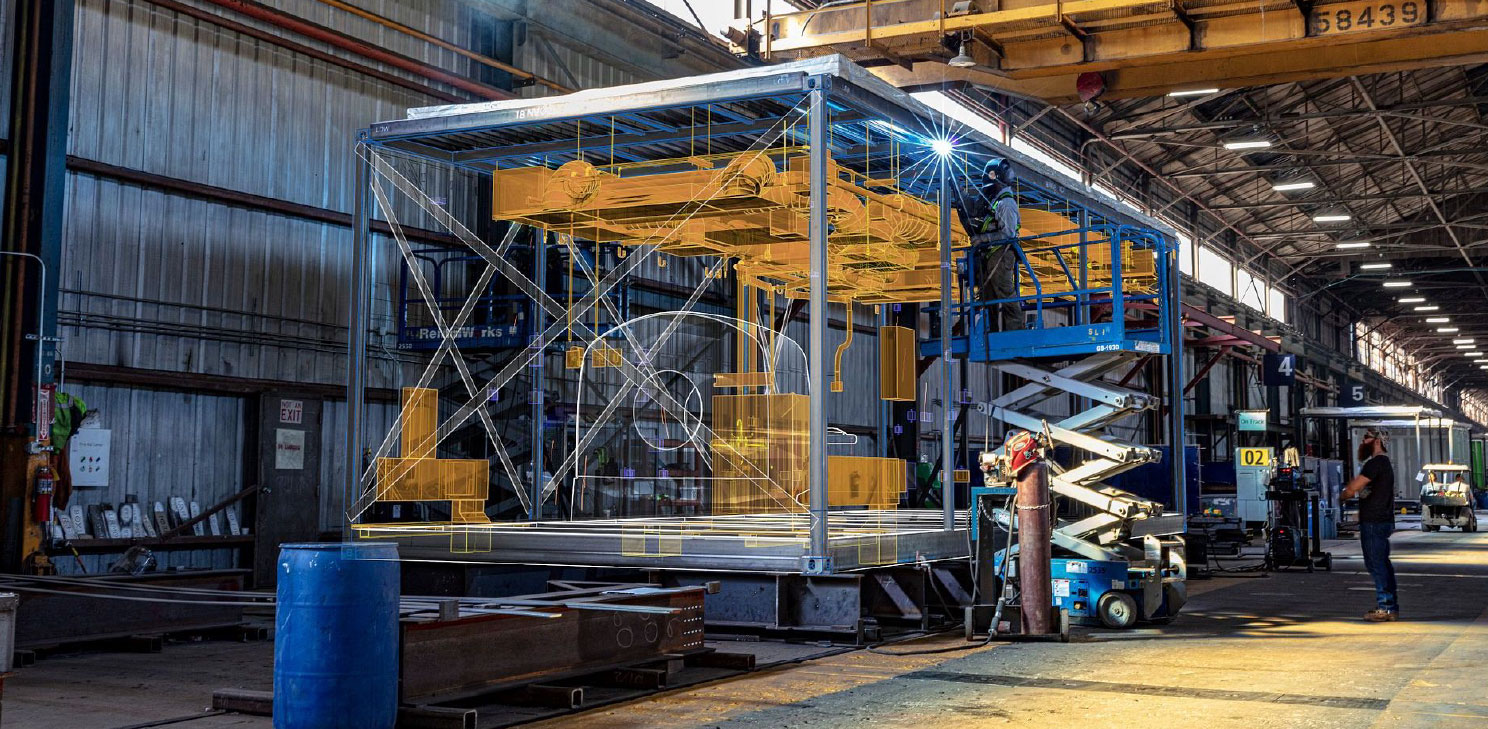
As mega facility construction shifts increasingly towards off-site manufacturing, factory QA for prefabrication has become one of the most decisive factors separating successful modular projects from costly, delay-ridden ones. Rather than waiting until modules reach site to discover defects, leading contractors are moving quality assurance, testing and commissioning activities upstream, into the controlled environment of the factory itself.
Factory QA for Prefabrication: From On-Site Discovery to Factory-Level Verification
Traditional “brick and mortar” construction has long followed a linear sequence: design, build, install, then commission once everything is in place. Modular delivery inverts this logic. Components are designed, manufactured and tested off-site while groundworks and site preparation proceed in parallel, a shift that can shave a significant proportion of time off a traditional build programme. For large, systems-heavy facilities such as data centres, semiconductor fabs and gigafactories, this parallel approach is increasingly viewed not as an optional efficiency gain but as a practical necessity.
Central to this model is the Factory Acceptance Test, or FAT: a structured sequence of inspections and functional tests carried out by manufacturers, and often witnessed directly by client representatives or independent commissioning agents, before a module ever leaves the factory floor. FAT verifies that a module’s quality, functionality and safety align with agreed design standards, catching issues that are difficult or impossible to detect once a unit is installed and operational on site, such as concealed pipework leaks, misaligned drainage gradients or intermittent electrical faults.
Layered Commissioning, Not a Single Event
Commissioning frameworks widely used in complex facility construction, such as those built on recognised whole-building commissioning guidance, break the process into distinct levels. Early levels cover factory observation testing to confirm test plans match design specifications, followed by site acceptance inspection once modules arrive. Later levels address functional performance testing of installed systems, culminating in an integrated systems test where the facility is proven to operate as a coherent whole. Crucially, factory-based testing allows portions of this sequence, including start-up and pre-functional testing, to run in parallel with ongoing site construction rather than waiting until installation is complete.
The benefits of front-loading testing in this way extend well beyond simple time savings. Bringing rigorous factory QA for prefabrication into the build process gives operators earlier visibility into how systems will actually perform and interact, reduces the volume of defects raised during later commissioning stages, and shrinks the number of specialist personnel required on site for extended periods. Digital tools now support this shift further, with punch lists managed electronically and virtual modelling used to simulate performance under extreme conditions before physical testing even begins, helping teams identify structural or systems issues earlier still.
A Note of Caution on System-Level Behaviour
It is worth noting that factory testing, however thorough, verifies modules largely in isolation. System-level behaviour, including protective device coordination, fault current contributions and grounding architecture across module boundaries, often only becomes fully apparent once units are interconnected on site. This means factory QA should be treated as a critical foundation rather than a complete substitute for coordinated, whole-system commissioning once installation is complete.
Conclusion
For mega facility projects under pressure to compress schedules without compromising reliability, robust factory QA for prefabrication offers a proven route to catching defects earlier, controlling costs and reducing on-site risk. As modular methods continue to mature, the factories where these facilities begin their life are becoming just as critical to project success as the sites where they are ultimately assembled.
To find out more about the latest industry updates and innovations in prefabrication for mega facility construction, meet with solution providers and hear talks from expert speakers, attend the Prefabrication for Mega Facilities Summit USA, taking place November 17-18, 2026, in Houston, Texas, USA
For more information, click here or email us at info@innovatrix.eu for the event agenda. Visit our LinkedIn to stay up to date on our latest speaker announcements and event news.