Lyophilization remains one of the most important tools in sterile aseptic drug manufacturing, particularly as the industry’s pipeline shifts toward biologics, mRNA therapeutics, and lipid nanoparticle formulations that are inherently unstable in liquid form. By freezing a formulation and then removing water through sublimation and desorption, manufacturers can extend shelf life, reduce cold-chain dependence, and protect fragile molecules from degradation. But as next-generation therapeutics grow more complex, so too does the discipline of lyophilization development, and recent innovation is reshaping both how cycles are designed and how vials move through the manufacturing process.
Smarter Lyophilization Development
Modern lyophilization development increasingly relies on thorough thermal characterization to define a formulation’s collapse temperature, glass transition point, or eutectic temperature before any cycle trials begin. Getting these values right matters: pushing primary drying even slightly closer to a formulation’s thermal ceiling can meaningfully shorten drying time, while exceeding it risks cake collapse, meltback, or high residual moisture. To manage this balance, process analytical technology has become central to contemporary lyophilization development programs. Tools such as tunable diode laser absorption spectroscopy, manometric temperature measurement, and wireless in-vial sensors now give formulators real-time visibility into sublimation rates and product temperature, replacing older trial-and-error approaches. Controlled nucleation technologies are also gaining traction, allowing manufacturers to trigger uniform ice crystal formation across a batch rather than leaving nucleation to chance, which improves consistency in pore structure and drying behavior from vial to vial.
Scale-up remains one of the toughest challenges in lyophilization development, since a cycle validated on laboratory equipment cannot simply be copied onto a production freeze dryer. Differences in radiative heat transfer, condenser capacity, and even cleanroom particulate levels can shift how a formulation dries at commercial scale, which is why mathematical modeling of dried-layer resistance and vial heat transfer is increasingly used to bridge the gap between bench and production equipment.
Automatic Vial Delivery Comes of Age
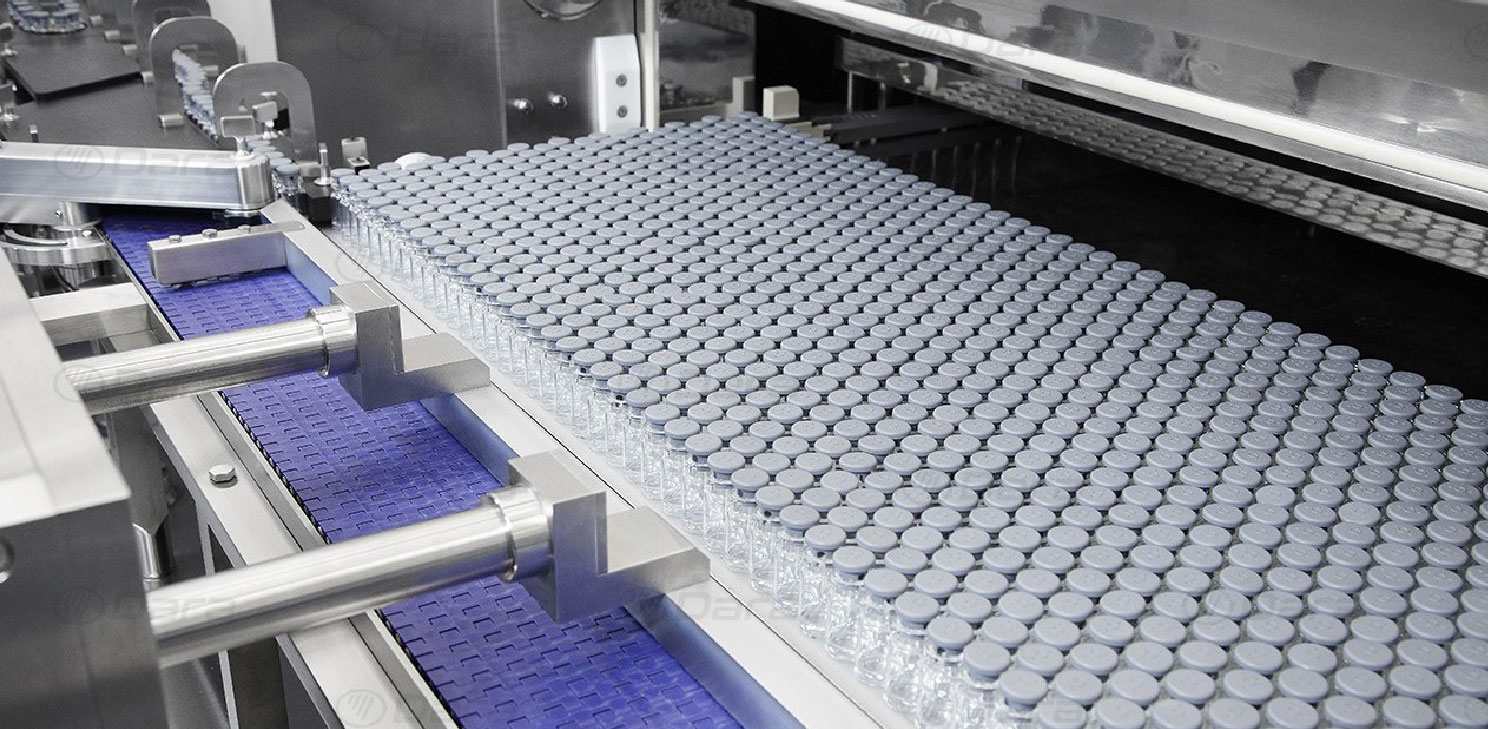
Alongside cycle design, how vials physically move through the process is also evolving. Traditional batch lyophilization loads trays of vials onto shelves, where uneven heat and vapor flow across the chamber can create edge-to-center variability. Newer continuous lyophilization systems address this by suspending individual vials and moving them through dedicated freezing and drying zones on magnetically levitated trays, avoiding the contact-induced wear and particulate risk associated with conventional shelf loading. Each vial carries its own inline sensor, enabling real-time monitoring of drying progress and creating the possibility of real-time batch release, while every vial experiences identical heat transfer conditions rather than the positional variation seen in static chambers.
Automated loading and unloading is equally significant from a sterility standpoint. Because vials enter the lyophilizer only partially stoppered, the transfer and loading steps are considered critical points for aseptic control, and automated, contactless vial handling reduces manual intervention and the associated contamination risk during this vulnerable stage of the process.
Delivery at the Point of Use
Innovation is not confined to the manufacturing floor. Dual-chamber cartridge autoinjectors are now automating reconstitution itself, combining a lyophilized drug and its diluent within a single device. Rather than the multistep vial-and-syringe process traditionally required, these systems can reduce reconstitution to a handful of simple actions, cutting preparation time, minimizing handling errors, and supporting safe self-administration at home.
Together, these advances in cycle science, automated vial handling, and reconstitution technology are converging to make lyophilized products faster to develop, more consistent to manufacture, and easier for patients to use. As demand for freeze-dried biologics continues to grow, the organizations that invest in this next generation of lyophilization development, from thermal characterization to automatic vial delivery, are best positioned to bring stable, reliably reconstituted therapies to patients efficiently and safely.
To discuss aseptic processing and the key issues facing the industry, connect with solution providers and network with delegates,, attend the 6th Aseptic BioPharma Processing Summit, taking place September 22-23, 2026, in Vienna, Austria.
For more information, click here or email us at info@innovatrix.eu for the event agenda. Visit our LinkedIn to stay up to date on our latest speaker announcements and event news