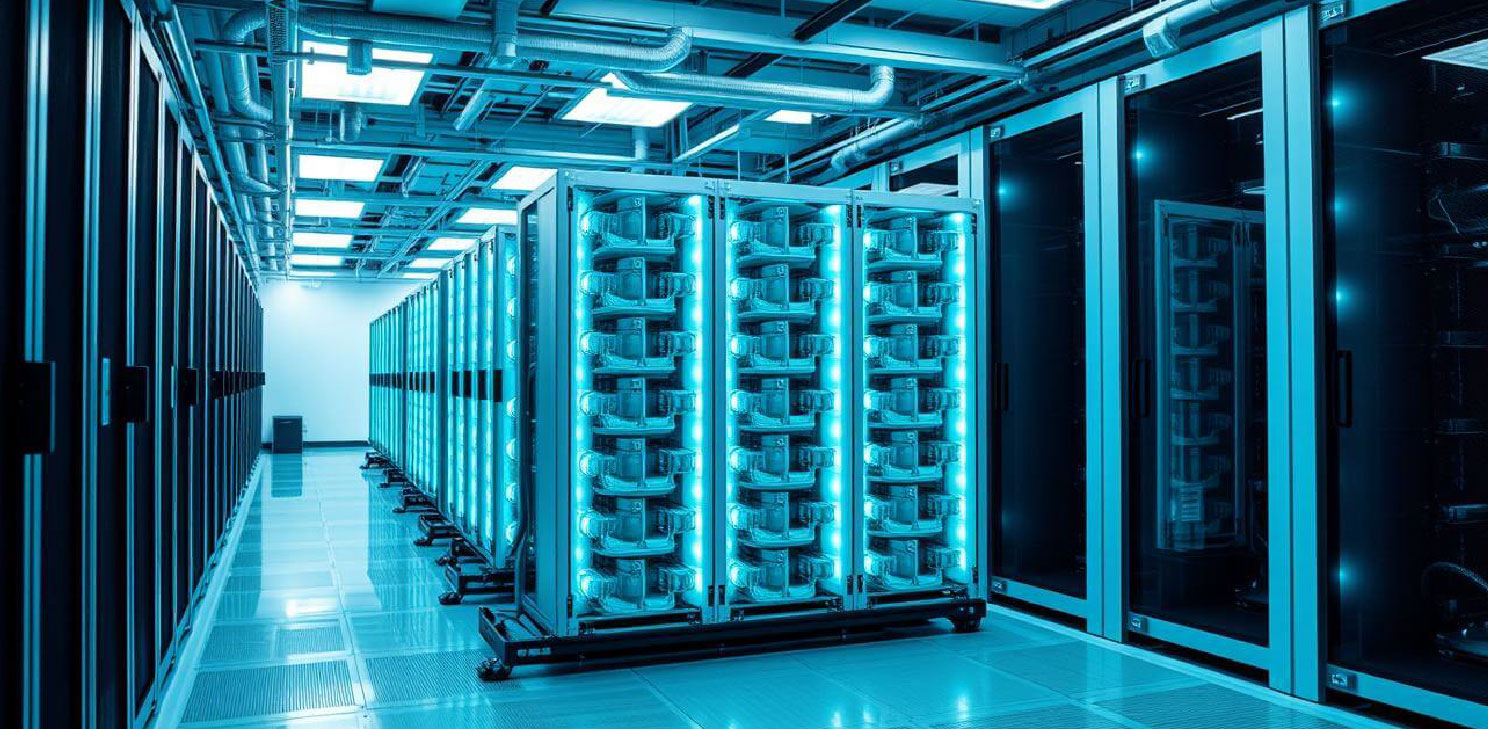
As artificial intelligence (AI) and high-performance computing (HPC) continue to evolve, the demands placed on data centre infrastructure are intensifying—particularly in terms of thermal management. The rapid rise in compute density has made high-load data center cooling a central concern for operators seeking to maintain performance, reliability, and efficiency.
The density of AI and HPC deployments is fundamentally reshaping cooling requirements. Traditional workloads typically operate within a range of 5–8 kW per rack, but AI and HPC systems can demand power densities five to ten times greater. In fact, current trends suggest that some deployments may exceed 100 kW per rack, with peak densities potentially reaching 150 kW in the near future. This dramatic increase translates directly into higher and more sustained thermal loads, challenging conventional cooling methods.
Historically, air cooling has been sufficient for most data centre environments. However, as density rises, air-only approaches are often no longer adequate. AI and HPC workloads—especially those involving deep learning and generative AI—require more advanced solutions such as direct liquid cooling (DLC), air-assisted liquid cooling (AALC), and rear-door heat exchangers. These innovations are redefining high-load data center cooling by enabling more efficient heat removal at scale.
That said, not all AI and HPC workloads necessitate liquid cooling. Cooling requirements depend on factors such as hardware type, vendor specifications, and workload intensity. For example, inferencing workloads are generally less power-hungry than training workloads and may still be effectively managed using traditional air cooling. Machine learning tasks typically demand fewer resources, whereas deep learning and generative AI require far more intensive computational environments.
Understanding these distinctions is crucial. Not every rack in an AI-driven facility will operate at extreme densities, and not every deployment requires the same level of cooling sophistication. This variability highlights the importance of tailored solutions rather than a one-size-fits-all approach. Data centre operators must work closely with experienced partners who can design customised systems aligned with specific workload demands.
One practical innovation for transitioning to higher density is the use of rear-door heat exchangers (RDHx). Installed at the back of server racks, these systems capture hot exhaust air and cool it using water before recirculating it into the room. Water’s thermal capacity—approximately 3,000 times greater than air—makes this approach highly efficient. RDHx solutions can also be combined with direct-to-chip cooling for even greater effectiveness as densities continue to rise.
Direct-to-chip cooling represents a major advancement in high-load data center cooling. In this method, coolant—typically water—flows directly across CPUs and GPUs via cold plates, absorbing heat at the source. This targeted approach minimises reliance on large fans, reducing energy consumption and freeing up space for additional computing hardware. As a result, data centres can achieve higher densities without compromising performance.
Single-phase direct-to-chip cooling has emerged as the preferred approach for many operators. In this system, the coolant remains in liquid form throughout the process, ensuring stable and predictable heat transfer. Compared to two-phase systems, single-phase cooling offers simpler maintenance and greater reliability, making it particularly well-suited to AI and HPC environments.
Supporting these systems is a suite of integrated thermal technologies. Coolant Distribution Units (CDUs) regulate temperature and flow, ensuring optimal conditions throughout the system. In-rack manifolds distribute coolant efficiently to each component, while cold plates provide direct heat dissipation from high-power chips. Rear-door heat exchangers further enhance the system by removing residual heat before coolant recirculation.
Beyond the technology itself, adopting advanced cooling strategies requires a shift in operational mindset. Traditional data centre practices have focused on keeping water away from IT equipment. In contrast, modern liquid-assisted systems involve controlled water circuits within racks and components. This transition necessitates updated processes, staff training, and careful planning to ensure safe and effective deployment.
Ultimately, the future of AI and HPC infrastructure depends on scalable, sustainable cooling solutions. As workloads grow more complex and energy demands rise, high-load data center cooling will play a pivotal role in enabling continued innovation. By embracing liquid cooling technologies—particularly direct-to-chip systems—organisations can support higher compute densities while reducing energy consumption and environmental impact.
In this rapidly evolving landscape, agility, scalability, and sustainable growth are essential. Those who invest in advanced cooling innovations today will be best positioned to meet the computational challenges of tomorrow.
To attend talks from industry leaders, connect with solution providers and network with peers, attend the 5th Constructing Next-Gen Data Centers Europe: Revolutionizing Planning, Design, and Engineering, taking place June 9-10, 2026, in Berlin, Germany.
For more information, click here or email us at info@innovatrix.eu for the event agenda. Visit our LinkedIn to stay up to date on our latest speaker announcements and event news.