Our first ever data center conference, the Constructing Green Data Centers Summit: Revolutionizing Planning, Design, And Engineering, took place in the international political hub of Washington, D.C, at the The Westin Washington Dulles Airport hotel this June 25th and 26th, 2025, attended by professionals from data center operations, infrastructure design, engineering, IT management, energy efficiency, security, and emerging technology providers. The two day conference had a wide and comprehensive agenda that involved dozens of presentations from expert speakers, panel discussions, and networking breaks.
Our delegates explored smart and green solutions for constructing new modern data centers along with retrofitting, innovations in modular buildings, liquid cooling, renewable energy, waste management, 5G-enabled data centers, getting the opportunity to collaborate with experts and drive transformative solutions in the field.
This article will provide a session recap for those who didn’t get the chance to attend and serve as a reminder for those who attended.
Building Sustainable AI data centers with Adaptive Reuse
Sean Farney, Vice President, Data Center Strategy Americas at JLL
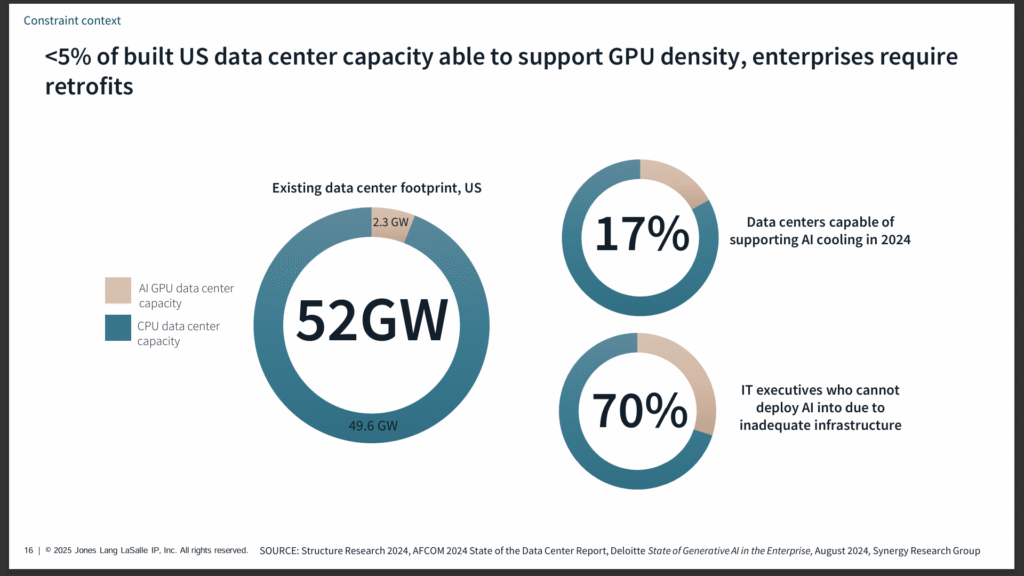
Sean shared how the amount of data created doubles every 4 years with colocation vacancy at the end of 2024 at 2.6%, while rents rose a blended 11% year on year. 72% of the 6.6GW of facilities being built in 2024 are preleased, leading to a 20%+ industry CAGR for data demand. However, the demand for GPU-capable data centers is increasing at a 39% CAGR, with only 4.6% of existing data centers able to handle AI density. Digital infrastructure capacity planners can reuse existing real estate and deploy a modular high-density solution and consider “Future Fitting” their projects by retrofitting your existing enterprise data center with stranded power. 10+ years of data center consolidation, de-duplication and Cloud migration initiatives have left large swaths of power stranded in corporate headquarters. Although these sites cannot support the liquid cooling and power density required for GPU storage & compute, they have ample chiller tonnage, generators, and staffing.
Sustainable Infrastructure Planning for AI Workloads: Balancing Density, Efficiency, and ESG Goals
Kyle Chien, Senior Director at Digital Realty
Kyle discussed how enterprises embarking on AI initiatives must address infrastructure requirements from the outset, as AI racks significantly increase density. Early planning is essential to future-proof data-centre designs, reduce deployment risks, and ensure the 12–24-month delivery timelines needed for strong ROI. Supporting high-density AI workloads and liquid-cooling systems introduces new design, resiliency, and operational complexities, including space allocation, airflow, cooling-loop placement, redundancy, monitoring, and serviceability. Procurement, permitting and supply-chain challenges add further pressure, encompassing logistics, insurance, ground-up builds versus retrofits, regulatory approvals across multiple disciplines, and critical interconnections. Sustainability considerations also shape decision-making as organisations prepare facilities for next-generation AI demands.

Case Study to Full Scale Mock-up/Sustainable Mass Timber Hot Aisle Containment (HAC)
Scott Brown, Mass Timber Specialist at DPR Construction
Hot Aisle Containment (HAC) systems consist of five key components: the base connector, column, panel connector, transverse panel, and main panel. Designed as a floor-supported solution, HAC speeds up commissioning through its robust support structure, innovative connection system, and prefabricated elements, while also helping reduce operational costs. Scot discussed how using mass-timber materials offers notable sustainability benefits, significantly cutting embodied carbon in data-centre construction. The approach supports broader sustainability goals by addressing both operational efficiency and construction impacts. Additionally, HAC systems are designed for straightforward deconstruction and reuse, reducing waste and extending material lifecycles across future data-centre projects.

Data Center Water Management: A Sustainable Approach to Mechanical Flushing
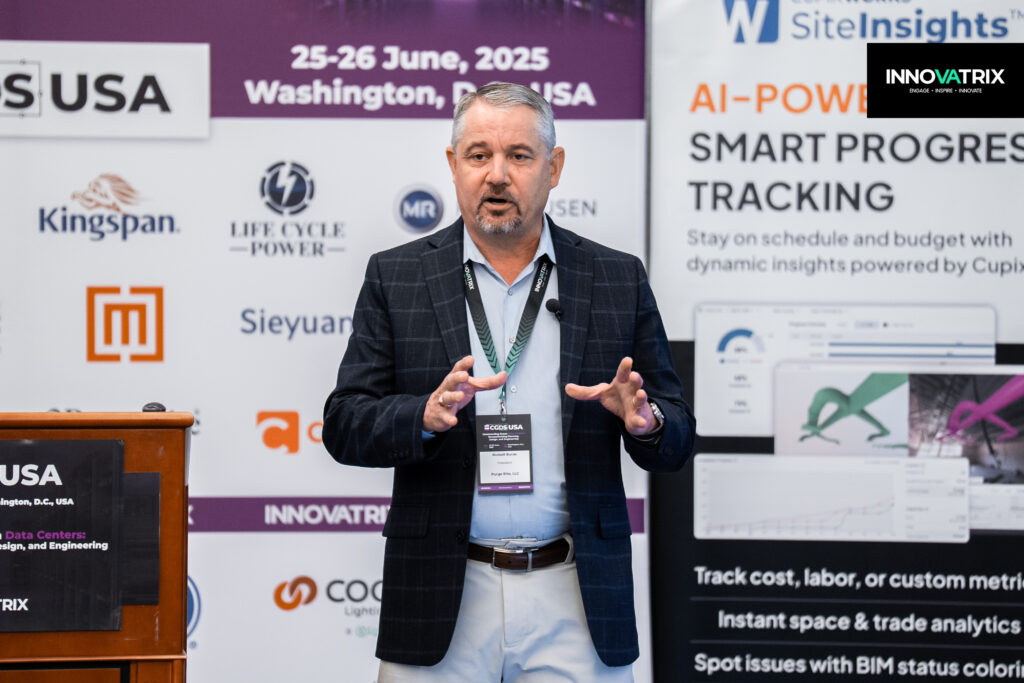
Russell V. Buras, CEO at PurgeRite
Mechanical flushing uses high-velocity water to clean data-centre cooling pipes, removing debris and contaminants that can impair performance or lead to equipment failure. Contaminated hydronic systems increase project costs and create challenges linked to make-up water availability, changing wastewater regulations, limited infrastructure, rapid deployment schedules, and rising expenses. Russell spoke to our audience about the patent-pending ‘NearZero’ closed-loop treatment system integrates into existing flushing processes to recycle wastewater, enabling a more sustainable and compliant discharge approach. NearZero reduces make-up water needs, minimises water haul-off and associated delays, cuts costs, and lowers CO₂ emissions linked to transport and disposal logistics.
The Next Frontier: Market Drivers & Considerations for Sustainable Data Centers
Emily Bowers, Senior Director of State & Local Affairs at Green Building Initiative
Emily shared how data centres apply integrated design, strong corporate sustainability policies, and careful site selection, favouring previously developed land with erosion controls, high-SRI roofing, and native planting. Energy strategies include air-cooled chillers, efficient building envelopes, BAS controls, daylighting, and smart lighting. Water use is reduced through WaterSense fixtures, minimal irrigation, and sub-metering. Material choices follow life-cycle cost analysis, with high waste-diversion rates and detailed O&M guidance. Indoor quality is supported by stringent ventilation standards, MERV 13 filtration, low-VOC materials, and outdoor views. Existing centres focus on high-efficiency chillers, energy-recovery systems, VSDs, water-saving fixtures, contamination-free sites, and waste-reduction policies. They use zero-ODP refrigerants, halon-free fire systems, CO₂ monitoring, acoustic controls, and comprehensive environmental management programmes.

Schedule-Centric Data Centers Design, Constraints, and Known Knowns: What Really Complicates Data Center Construction Planning & Scheduling?
Bahadir V. Barbarosoglu, Senior Manager at Holder Construction
Bahadir spoke to our delegates about how data centre construction is influenced by far more than the design itself. Beyond the blueprint, schedules are shaped by long-lead procurement, funding gates, permitting timelines, power and cooling availability, and constructability factors that often become the real drivers of delivery. Relying too heavily on “known-knowns” like past project data, assumed production rates, or optimistic durations creates a false sense of predictability, reinforced by Parkinson’s and Hofstadter’s laws. To build resilience, teams should map all potential driving paths rather than focusing solely on the critical path, integrate early constructability reviews, and regularly challenge assumptions. This approach improves flexibility, reduces risk, and leads to more reliable project outcomes.

Embodied Carbon and the Envelope – Decarbonizing Data center construction
Brent Trenga, Director of Sustainability at Kingspan Insulated Panels, Inc
Brent’s presentation demonstrated how whole-building life cycle assessment (LCA) can quantify the embodied carbon impacts of material choices in the building envelope. By comparing wall systems, the analysis shows substantial differences: Hybrid Core IMP panels produce 28% less embodied carbon than concrete systems and up to 89% less than PUR systems, with reductions reaching hundreds of thousands of kilograms of CO₂ for a typical warehouse project. Strategic design and specification of enclosure systems including structure, insulation and finishes can therefore significantly cut embodied carbon while also lowering cost and speeding construction. Selecting lighter, lower-carbon assemblies such as advanced insulated metal panels reduces material demand, simplifies installation and supports faster, more sustainable project delivery.

Small Modular Reactors as A New Frontier in Data Center Power
Amine Benbourenane, Senior Mechanical Engineer at NTT Data Centers
Amine explained that Small Modular Reactors (SMRs) are compact, factory-built nuclear reactors that generate power using the same principles as conventional nuclear fission but on a smaller, more flexible scale. They offer potential advantages for energy-intensive data centres, including a stable, low-carbon supply and reduced dependence on utilities. Benefits include dedicated infrastructure, large-scale cost savings, and possible new revenue streams. However, challenges are significant: strict regulation, specialist workforce shortages, heightened liability, competition with utilities, business-continuity risks, and geographical constraints. While nuclear energy will play an essential role in meeting wider power demands, co-locating SMRs with data centres presents major risks. Investment is better directed towards off-site nuclear generation and improving ageing national grid infrastructure for broader societal benefit.

Bridging the Power Gap: Overcoming Supply Chain and Utility Challenges in Infrastructure Development
Geoff Bland, SVP of Commercial Strategy at Life Cycle Power
Geoff shared how global supply-chain disruptions are delaying infrastructure projects and driving up costs. Permitting, siting issues, environmental reviews, local opposition, and overlapping jurisdictions all extend timelines. Although infrastructure spending has reached $25 billion per year, more than 90% is directed towards maintenance and reliability rather than expansion. Labour and equipment shortages, along with growing grid-connection queues, further slow progress. With utility power availability often years away, microgrids and “bring your own power” models are increasingly vital for closing short-term capacity gaps. Leased power allows capacity to scale with demand, while adopting low-emission technologies helps reduce air-permit delays, ammonia consumption, catalyst costs, and operational limits on run hours or installed capacity.

Environmental, Community, and Public Health Impacts from Data Center Development – Northern Virginia Case Study
Julie Bolthouse, Director of Land Use at Piedmont Environmental Council
Juloe spoke about how data centres create environmental pressures through high water, air, and energy use, alongside community impacts such as noise, land-use conflicts, and visually intrusive buildings. Solutions include more efficient buildings, hardware, software, and AI models, stronger management practices, and greater transparency and regulation. Currently, utility ratepayers often subsidise data-centre power needs due to discounted rates, outdated pricing structures, and transmission lines built exclusively for data-centre loads. This shifts cost and risk onto other customers while contributing to pollution, water stress, and setbacks to clean-energy progress. Recommended actions include stronger state oversight, clearer reporting, fair cost allocation, incentives for sustainability, reduced data usage, and wider adoption of clean-energy technologies, smart-grid solutions, and efficient cooling and storage systems.
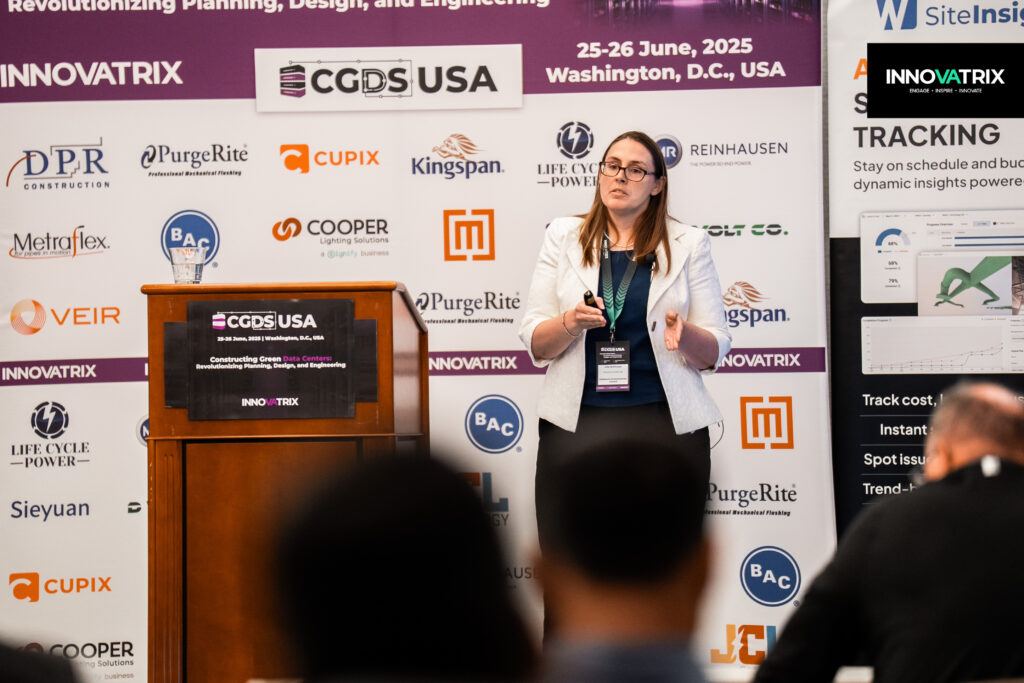

Bridging Intermittency: ‘The Strategic Role of Energy Storage in Sustainable Data Center Operations
Samaksh Kr. Sharma, Manager, Battery Energy Storage/Operations Engineering at RWE Clean Energy LLC
Samaksh shared his knowledge on how technologies are evolving beyond today’s dominant lithium-ion chemistries such as NMC and LFP, with solid-state and sodium-ion options offering future gains in safety and cost. Flow batteries, including vanadium redox and zinc–bromine, provide strong long-duration storage for multi-hour backup. With the global BESS market growing rapidly, data centres are increasingly integrating batteries to manage renewable intermittency, support peak shaving and load balancing, and improve resilience, as seen in recent Microsoft and Google deployments. Cost–benefit assessments must consider full lifecycle expenses and typical payback periods of three to seven years. Safety remains essential, supported by strict compliance, thermal management, redundancy, and AI-driven predictive maintenance to reduce risk and downtime.

Alternative Sources of Power
Jaime Martinez, Construction Program Manager at Microsoft
The United States hosts more than 3,700 data centres, reaching nearly 50 million square feet in 2024 and projected to exceed 105 million by 2030. Power use has risen sharply from 58 TWh in 2014 to 176 TWh in 2023, with forecasts of 325–580 TWh by 2028. Current energy sources span coal, gas, hydro, nuclear, solar, and wind, though environmentally conscious supply relies most on hydro and nuclear, with growing contributions from solar, wind, biomass, and geothermal. Jaime discussed how capacity is set to expand significantly through new solar, wind, and battery-storage installations, alongside future nuclear additions. Developers are advised to integrate alternative power into project planning, including onsite renewables and greater battery storage, while supporting state-level adoption of advanced nuclear and tidal energy.

Transforming Data Center Construction with AI-Powered Progress Tracking: Why Cupix Leads the Way
Ahmad Sabbouri, Director of Professional Services at Cupix
Reality capture and AI are becoming essential in data-centre construction, helping teams overcome challenges such as tight timelines, high client expectations, limited site visibility, delayed reporting, and inefficient QA/QC processes. Ahmad spoke about Cupix provides an integrated reality-capture platform that combines AI-driven 3D mapping from 360° video, laser scans, drone imagery, and BIM/VDC integrations. Its automated, AI-powered progress tracking enables colour-coded BIM visualisation, georeferenced accuracy, and rapid PDF reporting by level, subcategory, or reference plan. These tools deliver clear insights into what is not started, in progress, completed, or overdue. The result is improved collaboration, more reliable validation, and better outcomes for executives, project managers, technology teams, and facility operators through accurate progress monitoring and dependable as-built documentation.

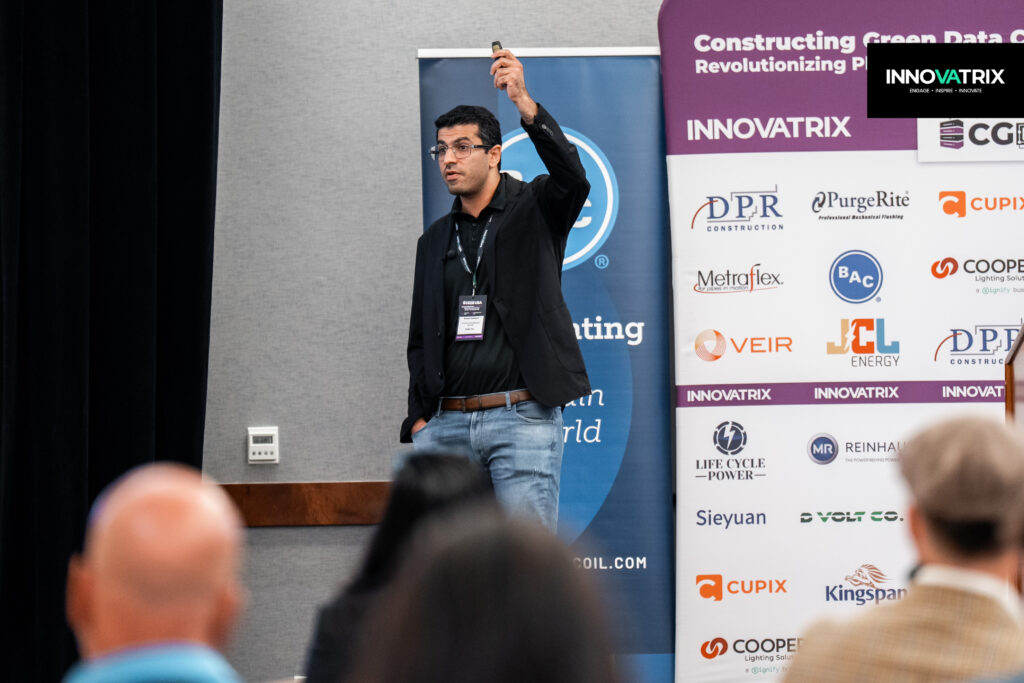
New Trends in Data Center HVAC
Scott Charter, Director of AI & Cloud Strategy at Oracle
Scott discussed how GenAI is being used to optimise HVAC performance by removing hazardous chemicals, using advanced oxidation processes, sensors, and AI to reduce blowdown and improve system efficiency. The approach focuses on preventing buildup, enabling continuous detection and adjustment, and coordinating operations through data-driven control. Emerging water-saving methods include micron filters, which improve approach temperatures and reduce downtime at lower cost. High-fidelity sensors provide real-time, self-calibrating data with exceptional accuracy, supporting predictive maintenance. AI further enhances energy efficiency by dynamically adjusting pump and fan speeds to cut power usage and equipment wear. In-operation tube cleaning with automated sponge-ball systems maintains optimal heat exchange without downtime, delivering substantial energy savings. Even closed-loop systems still require water treatment.

Impact of AI Infrastructure on Data Center Environment, Health & Safety Program Management
Adam Board, Senior Vice President, EHS at T5 Data Centers
Adam spoke about how faster construction timelines are increasing the need for proactive safety built on pre-task planning, integrated scheduling, real-time hazard detection, strong leadership engagement, and clear training and communication. AI-driven tools such as DroneDeploy’s Safety AI now identify up to 95% of visible risks automatically, extending the reach of safety teams and enabling issues to be resolved within hours. Automated walk reports provide accurate, shareable insights aligned with OSHA standards and link directly to project issues. A cultural shift is also under way: traditional metrics like TRIR are inadequate for predicting serious incidents. Future-ready organisations prioritise understanding SIF risks, encourage transparency, and view safety as the presence of reliable systems and informed leadership rather than merely the absence of recorded incidents.

Building a Green AI Future: Sustainable Data Center Strategies
Phill Lawson-Shanks, Chief Innovation Officer at Aligned Data Centers
Phill’s presentation highlighted how hybrid and adaptive cooling systems improve energy efficiency while enabling waterless heat rejection to conserve water. It emphasises end-to-end carbon tracking—using tools such as OriginMark™ and Environmental Product Declarations—to monitor embodied carbon from the supply chain through the full data centre lifecycle, supporting net-zero progress. Prefabricated, skidded and modular infrastructure enables faster construction, higher quality and scalable, low-waste deployment. Certifications such as the Green Building Initiative’s Green Globes reinforce sustainable practices, with Aligned achieving multiple high-level certifications. The presentation also explores emerging on-site power options, including Small Modular Reactors (SMRs), which offer long-running, resilient, self-cooling nuclear power and could reduce future reliance on traditional grid infrastructure.

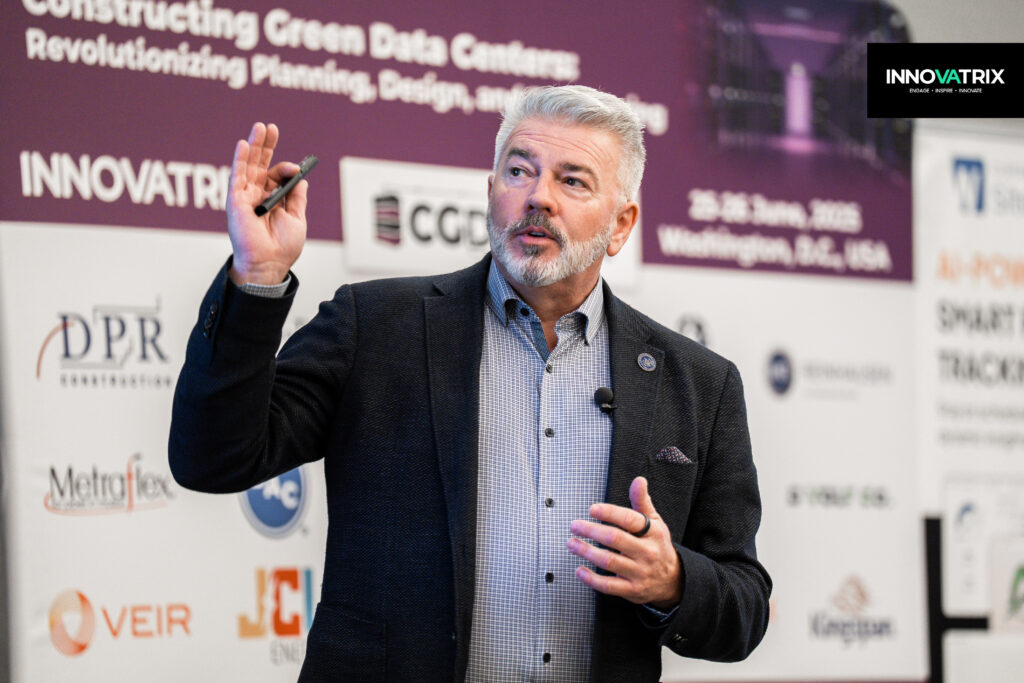
High Density Cooling for a sustainable world
Julian iosifescu, Global Director BD Data Centers at Baltimore Aircoil Company
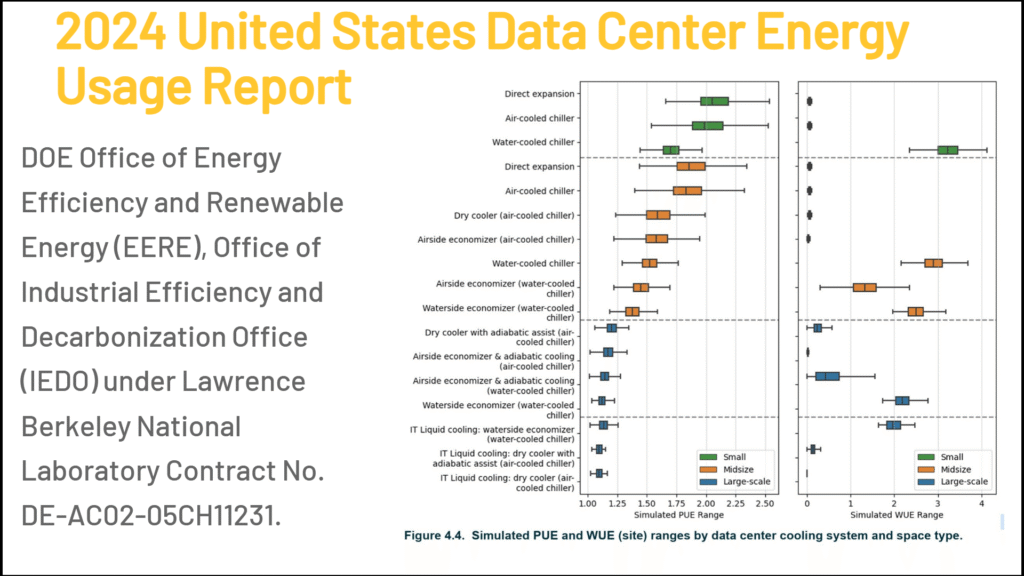
Julian spoke to our audience about liquid cooling enabling higher rack densities and greater efficiency across diverse climates, making it increasingly important for AI and HPC data centres. Rear-door heat exchangers cool servers with chilled water behind the rack, cold plates deliver cooling directly to components, and immersion systems submerge hardware in dielectric fluid for maximum heat removal. These approaches help tackle key challenges: lowering PUE, reducing WUE, and cutting carbon emissions. Success depends on partnering with providers who offer strong customer experience, global capacity, flexibility, sustainability leadership, and a robust product portfolio. The industry is now actively transitioning from traditional air-cooled facilities to liquid cooling in preparation for high-density computing demands.

Sustainable Storage And Data Embassies: Data Embassies on Earth and In Space with Resiliency as a Service (RaaS)
Chris Stott, Founder & CEO at Lonestar Data Holdings
Chris discussed how his company Lonestar will put the first data centers on the moon. We must use every technological tool available to us to make sure we are storing data sustainably, and so we must look to space as a tool to be used to make sure we have a future. Space can serve as a new data centre region as sovereignty over your data is made possible thanks to treaties from decades ago that made space a highly regulated space with regard to international law. Lonestar has completed two missions, with another going to lunar orbit planned for 2027. Lonestar combines the best of both the data and space industries, providing premium data backup for resilient sovereign data storage and disaster recovery, high security for mission-critical data and resiliency that reduces operating expenses.

Data Center Resiliency in the age of AI
Srinivas Garimella, Senior Manager, Data Center Systems at Google
AI models are scaling explosively, projected to reach 20 trillion parameters by 2030, driving rapid hardware evolution and coevolution of infrastructure. Srinivas shared how pace creates challenges: accelerated obsolescence, underutilised systems, premature decommissioning, e-waste, and energy inefficiency. Fault-tolerant solutions extend hardware lifespan, enable reuse, optimise energy use, minimise downtime, and delay costly upgrades. Modularity allows partial system upgrades, repurposing, and power-saving, reducing e-waste and improving economic efficiency. Achieving resilient AI infrastructure requires standardisation across hardware and orchestration layers, a forward-compatible architecture, and strategies that keep pace with AI evolution. Combining fault tolerance, modularity, and holistic planning ensures efficient, sustainable, and future-ready data-centre operations.

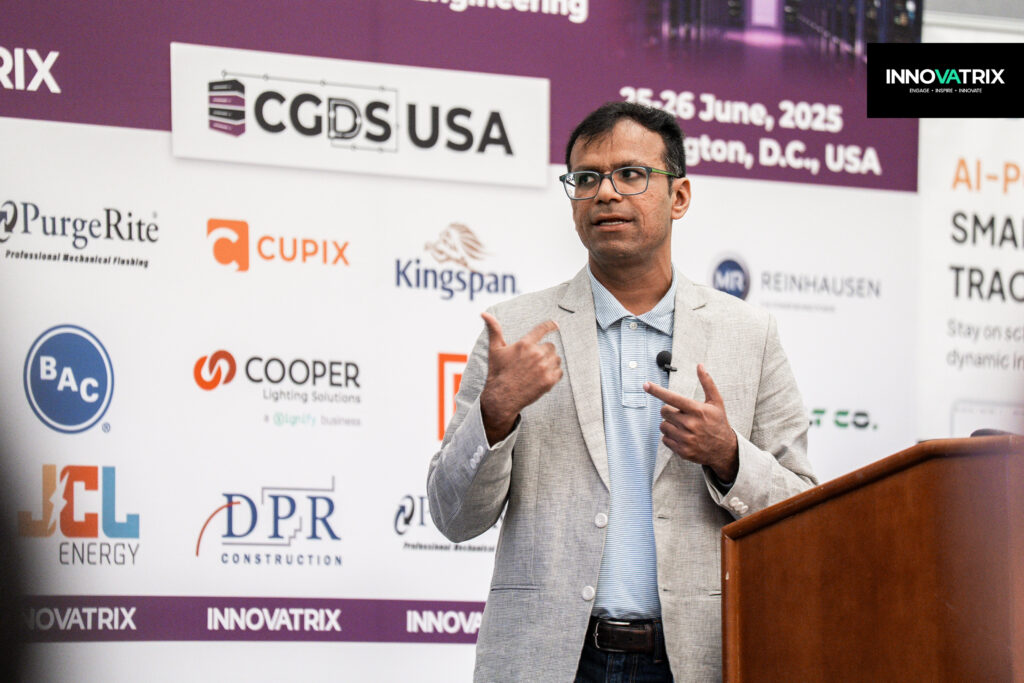
evoZero®: Reducing Embodied Carbon in Data Center Construction With the World’s First Industrial Scale Carbon Captured Cement
Ignacio Cariaga, Commercial Sustainability Director at Heidelberg Materials
Iganacio discussed how embodied carbon remains a significant and largely irreversible contributor to data-centre construction emissions, accounting for around 70% of non-MEP CO₂. Carbon Capture, Utilisation, and Storage (CCUS) in cement offers a scalable approach to reduce this impact. evoZero® is the world’s first industrial-scale, net-zero cement, produced using Heidelberg Materials’ advanced CCUS portfolio, including the Brevik facility which captures 400,000 tonnes of CO₂ annually. This innovation allows data centres to cut Scope 3 emissions substantially without affecting performance or project timelines. By integrating net-zero cement into construction, developers can achieve a practical, transformative pathway towards lower-carbon, sustainable data-centre buildings.

Dos and Don’ts and Everything In-Between for Data Center Cooling Water
Raj Vaidya, Water Infrastructure Director at PCL Construction
Data centre cooling strategies vary widely in water use and efficiency; Raj shared how evaporative cooling (DEC) consumes high water but suits dry climates, while indirect evaporative cooling (IEC) uses moderate water with clean separation. Chilled-water systems are common in hyperscale facilities but demand significant water, whereas air-cooled systems use none at the cost of higher energy. Emerging approaches like direct-to-chip cold plates and liquid immersion cooling minimise water use and excel for high-density, GPU-heavy workloads. Hybrid cooling allows seasonal switching for efficiency without full redesign. Deployment requires careful attention to water chemistry, containment, maintenance, specialised hardware, and dielectric fluid handling. Optimised liquid cooling improves reliability, efficiency, and adaptability to evolving high-performance computing demands.
AI/IT – Friend or Foe
Bart Waress, VP of IT, Global at Vantage Data Centers
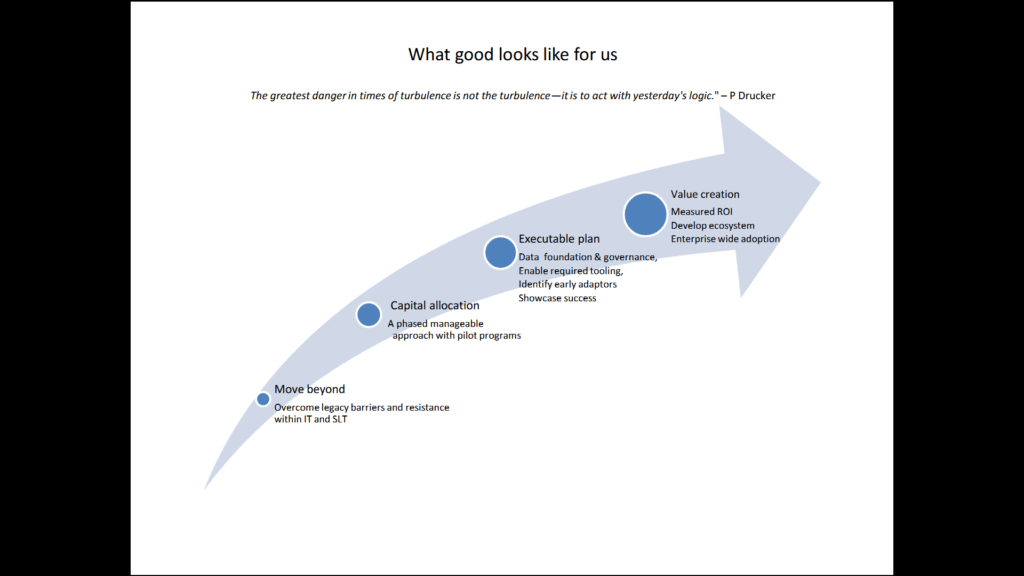
Bart spoke about how IT plays a central role in organisational AI initiatives, automating operations, enhancing cybersecurity, providing real-time insights, and accelerating software development. IT teams must lead AI governance and integration, reskilling staff to work alongside AI, adopting agile architectures, and treating AI as a tool rather than a threat. Intelligent infrastructure management enables predictive maintenance, real-time thermal mapping, capacity planning, and resource optimisation, while autonomous operations and maintenance leverage AI monitoring, automated workflows, and DevSecOps to cut operational costs by 20–30%. Energy efficiency benefits from intelligent cooling, dynamic power distribution, and load balancing. Compliance with frameworks such as the EU AI Act, CIFUS, GDPR, and sector-specific regulations is essential to mitigate multi-jurisdictional legal, ethical, and operational risks, including substantial financial penalties.
Sponsors
The Constructing Green Data Centers Summit: Revolutionizing Planning, Design, And Engineering was supported by a wide range of sponsors who brought their teams to our exhibition hall, and Innovatrix would like to thank them again for their support.
If you want to attend our next summit serving the data center construction sector and have the opportunity to hear presentations like these and many more, join us for our next CGDSUSA event, taking place next year, discussing the design and engineering of battery manufacturing facilities in particular. Discover the latest innovations and trends in smart and green solutions for constructing and retrofitting data centers, meet with solution providers and hear talks from industry leaders, attend the 3rd Constructing Green Data Centers: Revolutionizing Planning, Design, and Engineering, taking place February 10-11, 2026, in Las Vegas, Nevada, USA.
For more information, visit our website or email us at info@innovatrix.eu for the event agenda. Visit our LinkedIn to stay up to date on our latest speaker announcements and event news.