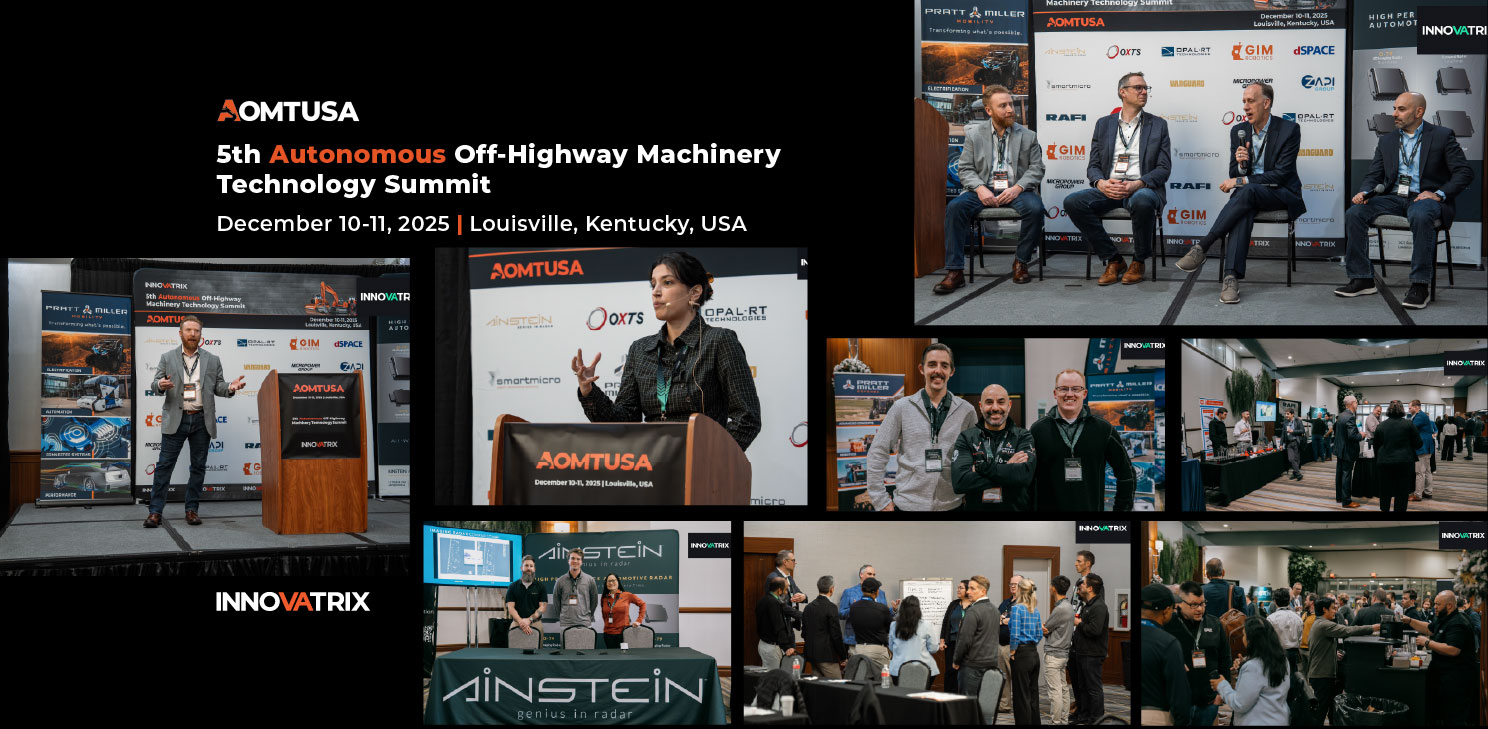
The AOMTUSA – 5th Autonomous Off-Highway Machinery Technology Summit took place from December 10th to 11th, with attendees from all over the autonomous off-highway machinery industry coming together at the Holiday Inn Louisville East – Hurstbourne. The two day conference had a wide and comprehensive agenda that involved dozens of presentations from expert speakers, panel discussions, and networking breaks.
Our attendees explored the latest breakthroughs in autonomous machines, AI, deep learning, advanced sensor solutions, software, and data management, along with the regulatory and ethical aspects associated with these innovations.
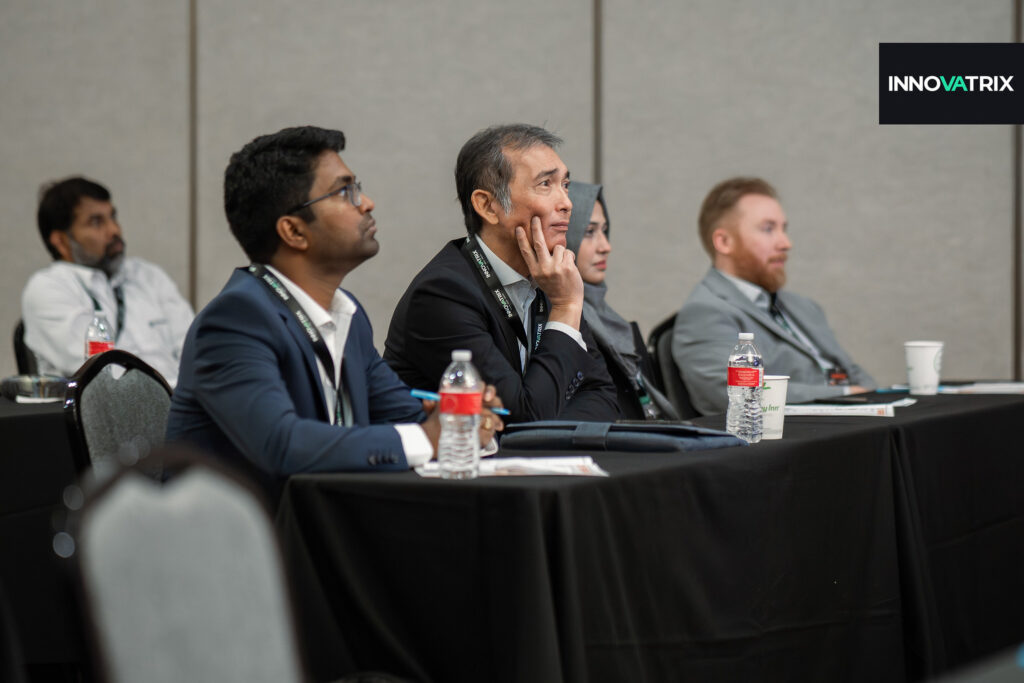
This article will provide a session recap for those who didn’t get the chance to attend and serve as a reminder for those who attended.
Considerations for Autonomous Haulage Adoption
Phillip Tinoco, Director of Surface Ecosystem at Newmont Corporation

Phillip outlined the key considerations for successfully implementing and scaling autonomous haulage operations, emphasising that preparation and people are fundamental to long-term success.
He highlighted the importance of thoroughly evaluating site readiness by understanding operational performance, cultural dynamics, existing processes and the impact of autonomous technologies. Early engagement with regulators and equipment manufacturers, alongside realistic performance targets and delivery timelines, are critical during the planning phase.
Phillip stressed the need for comprehensive workforce planning, including skills assessments, gap analyses, training forecasts and stakeholder capacity planning. Effective training programmes, standardised reporting and analytics, and strategies for employee retention and workforce turnover are essential when preparing for operational deployment.
Successful expansion relies on strong leadership, clear communication of objectives and actively listening to feedback from personnel. Providing development opportunities helps to build engagement and capability across teams.
Finally, Phillip emphasised the value of establishing robust organisational standards and optimised structures to support growth at scale, while remaining mindful of regional support limitations and the cultural and language differences that can influence implementation across global operations.
Rolling Out Safe Autonomous Solutions with AI for Ag, Construction, Logistics, and Landscaping
Mel Torrie, CEO/Founder at Autonomous Solutions (ASI)

Mel discussed the deployment of AI-enabled autonomous solutions across industries including agriculture, construction, logistics and landscaping, highlighting how scalable fleet management can improve productivity and safety. Central to this approach is a technology platform that combines AI-driven vehicle automation with multi-vehicle orchestration, enabling operators to manage autonomous and manned vehicles remotely through cloud or local server infrastructure.
The platform supports a range of connectivity options, including LTE, Starlink and WiFi, providing flexibility for deployment across diverse environments. By integrating vehicle monitoring, data logging and coordinated operations, it enhances situational awareness and supports safer interactions between operators and autonomous systems. A case study demonstrated productivity levels reaching 105%, illustrating the potential operational benefits of large-scale autonomous fleet management.
Mel also outlined the importance of functional safety in industrial autonomous systems. This includes a hybrid approach that draws upon ISO standards and Systems-Theoretic Process Analysis (STPA), alongside graphical safety cases and risk controls designed to identify, mitigate and manage hazards throughout development and deployment.
Trailblazing Autonomy: Faster Testing, Smarter Simulation, Quicker to Market
Marie-France Laurin, Autonomous Technology Consultant at OPAL-RT TECHNOLOGIES

Marie-France highlighted the growing role of virtual testing and simulation in accelerating the development of autonomous technologies across multiple industries. By reducing scenario and model development time by up to 70%, virtual environments can significantly lower testing costs, minimise risk and improve scalability from research projects to industrial deployments.
In agriculture, simulation enables the development and validation of autonomous systems for harvesting, crop monitoring, terrain-aware spraying and drone imaging. Photorealistic environments and synthetic data allow developers to test object detection, sensor fusion and adaptive control systems without relying on seasonal field conditions. The ability to simulate full crop cycles and varying weather conditions provides a reliable and repeatable framework for validating AI-driven solutions.
Marie-France emphasised the importance of simulation platforms that support realistic sensor suites, hardware-in-the-loop testing and compatibility with common robotics toolchains. These capabilities help bridge the gap between simulation and real-world deployment.
Beyond agriculture, simulation is driving innovation in mining, defence and academic research by enabling safer testing of autonomous vehicles, multi-agent systems and mission-critical scenarios. Virtual testing offers a faster, smarter and more flexible pathway to bringing autonomous technologies to market.

Delivered Autonomy: A practical path to the future of off highway intelligence
Estela Nario, Product Manager for Autonomy at Danfoss Power Solutions

Estela explored how autonomy is being applied practically within off-highway industries to address persistent challenges, including labour shortages, skills gaps and equipment-related accidents. Rather than pursuing fully autonomous machines in all applications, the industry is increasingly adopting specialised solutions that prioritise productivity, precision and safety.
The presentation highlighted a shift towards intelligent machines designed for specific tasks, with a focus on delivering measurable operational benefits. Practical autonomy is achieved through purposeful technology, custom integration and software-driven control systems that can be tailored to individual use cases.
Several real-world examples demonstrated the value of this approach. A fully autonomous manure vacuum improved productivity by operating 60% faster than a human operator while safely navigating confined spaces. An autonomous cargo loader increased efficiency through precise docking capabilities and reduced the risk of impacts. Operator assistance systems for haulers were shown to improve navigation, reduce operator error and enhance path-following accuracy.
Estela concluded that the future of off-highway autonomy lies in specialised, intelligent machines that deliver practical outcomes. Successful deployment will be driven by solution-focused autonomy that meets industry needs through targeted, reliable and scalable technologies.
Honda Solution Systems To Solve Industrial Challenges
Tsutomu Wakitani, Vice President, Executive Chief Engineer at American Honda Motor Co., Inc.

Tsutomu examined the industrial challenges facing sectors such as construction and landscaping, focusing on labour shortages driven by demographic changes and increasingly demanding working conditions. Risks associated with injury, noise and vibration are contributing to workforce gaps and placing greater emphasis on productivity, safety and operational efficiency.
The presentation outlined a human-centred approach to autonomy, where collaboration between workers and machines is prioritised. Flexible, easy-to-use and affordable autonomous systems are being developed to meet customer expectations while improving workplace safety.
Autonomous technologies powered by AI enable machines to understand their environment, recognise tasks and make informed decisions through contextual awareness and real-time planning. This supports safer and more efficient operations across a range of industrial applications. Cloud-based integration further enhances performance by allowing real-time data exchange, adaptive planning and coordinated machine control through connected platforms and APIs.
Tsutomu highlighted that the future of industrial autonomy will depend on creating scalable, data-driven ecosystems that minimise downtime and operate effectively in diverse environments. Key challenges remain in developing cost-effective environmental perception technologies and improving market acceptance of autonomous solutions.
John Deere’s journey towards Autonomy
Gregor Sueck, Vice President, Tractor Engineering at Deere & Company

Gregor outlined the progress being made in autonomous technologies and the strategic approach being taken to address workforce and productivity challenges across industrial sectors. Labour shortages remain a significant issue, with businesses struggling to fill skilled positions in agriculture and construction, while growing infrastructure demands continue to place pressure on productivity.
The presentation highlighted the importance of a smart industrial operating model that combines production systems, advanced technology platforms and lifecycle solutions to support autonomous operations. Rapid advancements in software development, connectivity and sensing technologies are enabling increasingly capable autonomous machines. Improvements in satellite communications have expanded machine connectivity, while developments in stereo cameras, artificial intelligence, LiDAR and radar are enhancing environmental perception, accuracy and operational efficiency.
Gregor demonstrated how these technological advancements are shaping the next generation of autonomous equipment. The latest autonomous systems are more rugged and better suited to demanding operating environments, offering improved reliability and performance. Fully electric autonomous machines also present opportunities to reduce noise and emissions while supporting more sustainable operations.
Autonomy is increasingly becoming a practical solution for addressing labour shortages, improving productivity and advancing industrial innovation.
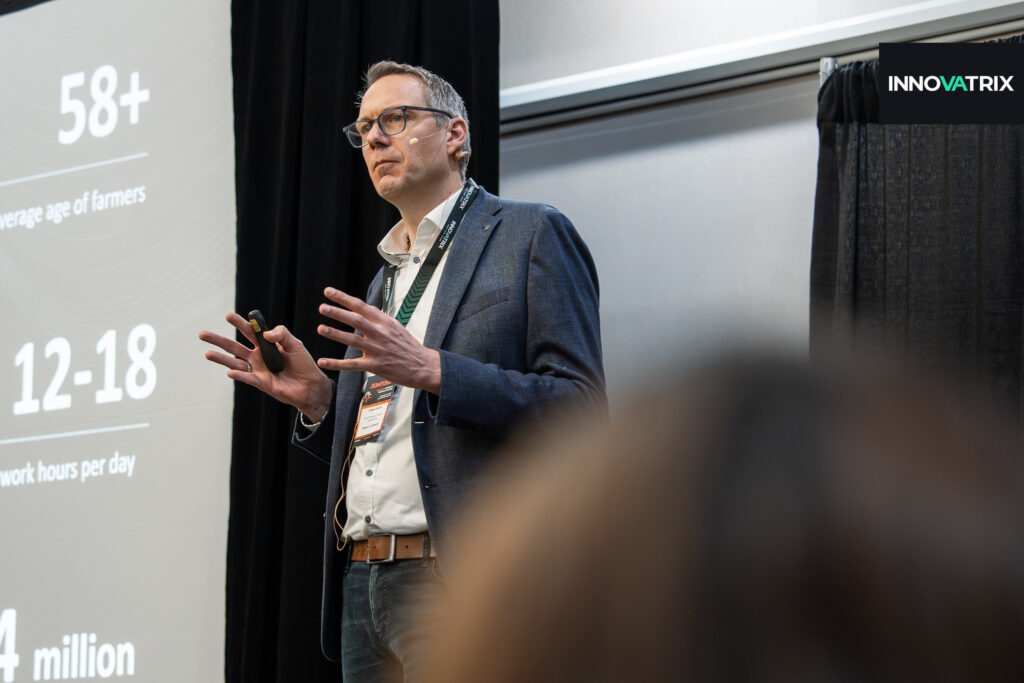
The Superpowers of AI Agents
Sarah Cohen, Head of Learning at AMESA: Advanced Modular Enterprise Systems of Autonomy

Sarah explored how AI agents can replicate human-like decision-making to solve complex industrial challenges that have traditionally relied on expert knowledge and years of experience. By combining machine learning, deep reinforcement learning, knowledge graphs, optimisation techniques and large language models, AI systems can perceive their environment, learn from feedback, develop strategies and communicate effectively.
The presentation demonstrated how these intelligence characteristics can work together to create autonomous systems capable of making high-value decisions. Knowledge graphs, in particular, provide a structured way of modelling complex processes, enabling AI to understand relationships and make more informed decisions.
Sarah emphasised that successful autonomy requires three key elements: practice with feedback, specialised skills and effective orchestration. Simulation environments play a critical role in training AI by generating realistic scenarios and enabling continuous learning. Multi-agent systems allow specialised AI agents to work collaboratively, with each agent performing distinct tasks to improve performance and explainability.
The deployment of autonomous systems should be tailored to the appropriate level of autonomy, from decision support to fully autonomous operation. Identifying high-value use cases and continuously evaluating and refining AI models are essential steps towards building practical and intelligent autonomous solutions.
Radar Intelligence for Autonomous Off-Highway Machines
Zongbo Wang, CEO at Ainstein AI, Inc

Zongbo examined the role of radar technology in enabling reliable autonomy for off-highway machines operating in demanding environments. He explained that radar offers significant advantages over other sensing technologies by providing accurate range, speed and motion detection in all weather and lighting conditions, including rain, fog, dust and darkness. Radar also delivers direct velocity and distance measurements while requiring less computing power for many applications.
The presentation highlighted the unique challenges faced by off-highway industries, including dust and mud contamination, vibration, electromagnetic interference, unpredictable obstacles and complex equipment configurations. Despite these challenges, lower operating speeds, controlled work environments and repetitive tasks create strong opportunities for rapid deployment and return on investment through staged autonomy.
Zongbo outlined key technological developments that are improving radar performance, including advanced antenna designs, low size, weight and power requirements, adaptive waveforms, scalable embedded processing and robust calibration methods. These innovations support reliable operation while maintaining affordability and flexibility across multiple applications.
A collaborative development approach was also emphasised, with early testing, continuous engagement and customer-focused design helping accelerate product validation and market adoption. Zongbo concluded that radar is becoming a critical reliability layer for autonomous machines, improving safety, precision and operational uptime while helping organisations bring autonomous solutions to market more quickly.
Unlocking Autonomy: GNSS and the Next Frontier in Off-Highway Vehicle Intelligence
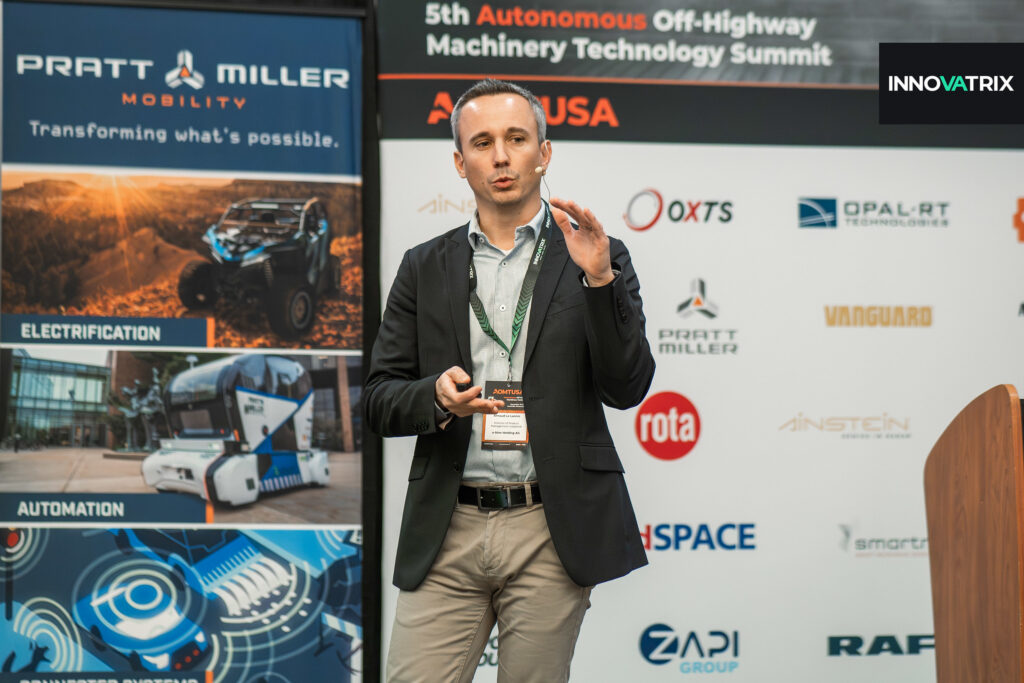
Arnaud Le Lannic, Business Development Director at u-blox

Arnaud discussed the latest developments in high-precision GNSS technology and its growing importance in autonomous off-highway vehicles. As industrial applications demand increasingly accurate positioning, traditional single-band receivers are no longer sufficient. Advances in satellite constellations, civilian frequencies and satellite-based correction services are making centimetre-level positioning more accessible and cost-effective across a range of industries.
The presentation highlighted the capabilities of modern all-band GNSS receivers, which provide high-accuracy positioning data and support global correction services for applications in agriculture, automation and surveying. Flexible correction services enable organisations to optimise operating costs while maintaining reliable, high-precision positioning across large fleets and remote locations.
Arnaud also emphasised the critical role of GNSS technology in ensuring the safety of autonomous agricultural and industrial machinery. Reliable localisation is essential for preventing collisions, maintaining situational awareness and ensuring accurate navigation and machine control. Compliance with functional safety and cybersecurity standards is becoming increasingly important as new regulations approach.
Early adoption of safety-ready GNSS components will help manufacturers reduce development timelines, simplify certification processes and build more reliable autonomous systems. High-precision positioning is set to play a fundamental role in the future of autonomous machinery and off-highway vehicle intelligence.
Deploying Autonomy for the Mixed Fleet in Agriculture
Darcy Cook, Sr. Director Autonomous Solutions at AGCO/PTx

Darcy explored how retrofit autonomy and mixed fleet compatibility are accelerating the adoption of autonomous technologies in agriculture. By adding autonomous capabilities to existing machinery, farmers can rapidly benefit from new technologies without replacing their current equipment, providing a practical and cost-effective pathway towards automation.
A mixed fleet approach enables autonomous solutions to operate across multiple equipment brands and models, helping farmers optimise their machinery investments while addressing labour shortages and improving operational efficiency. Autonomous systems can support consistent performance across key farming tasks and allow skilled workers to focus on higher-value activities throughout the crop cycle.
Darcy highlighted both the advantages and challenges of retrofit autonomy. Benefits include faster market deployment, rapid product improvements driven by customer feedback and access to a large installed base of agricultural machinery. However, supporting a diverse range of machines introduces complexities in system integration, verification and ongoing support.
The presentation also outlined the expected stages of autonomy adoption within the agricultural sector. Retrofit solutions are well suited to early adopters and provide valuable learning opportunities before broader factory-integrated systems emerge. Continuous product development is already enabling autonomous capabilities to expand across harvesting, tillage and fertilising applications, demonstrating the rapid progression of mixed fleet autonomy in modern farming.
Taking Autonomy Off-Road: Advancing Standards and Simulation to Support Off-road Autonomous System
Timothy Sellers, Postdoc at Mississippi State University

Timothy discussed the unique challenges associated with developing autonomous systems for off-road environments and the role of modelling, simulation and industry standards in accelerating their adoption. Autonomous technologies have significant potential to address labour shortages, improve safety and increase efficiency across agricultural and other off-road applications while creating opportunities for more highly skilled roles.
The presentation highlighted the importance of developing simulation standards that accurately represent the complexity of off-road environments. Unlike on-road systems, autonomous machines operating in agriculture, construction and mining must interact with varied terrain, deformable materials, water and objects that possess realistic physical properties. Advances in digital twins and simulation-driven design are helping bridge the gap between laboratory research and real-world deployment.
Timothy emphasised that collaboration between academia, industry and government is essential for creating scalable and interoperable autonomous systems. Model-based development, rigorous testing frameworks and open standards will support faster technology transfer while improving system reliability and performance.
Future progress will depend on addressing challenges in perception, mobility and behaviour within unstructured environments, alongside developing the workforce skills needed to support autonomy-enabled industries.
Crossing the Autonomy Chasm: Case Studies in Accelerating AOHM into Production
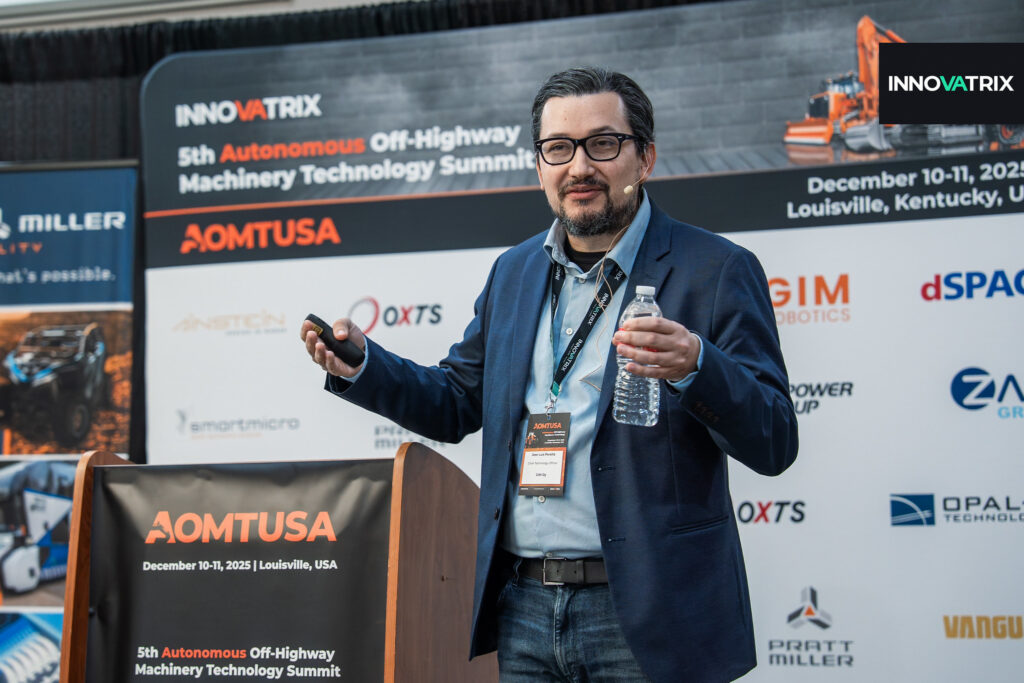
Jose Peralta, CTO of GIM Robotics

Jose examined how modular autonomous technologies can help accelerate the commercialisation of autonomous off-highway mobile machines by reducing development time and enabling faster deployment. Organisations are increasingly adopting autonomy to improve operational efficiency, safety, quality and productivity across a range of industries.
Drawing on several real-world case studies, Jose demonstrated how autonomous and assistive technologies are delivering value in sectors including rail, logistics, agriculture, forestry, environmental maintenance and maritime operations. Benefits include collision avoidance, automated cleaning and material handling, enhanced situational awareness, improved navigation and reduced operator workload. These applications have shown that successful autonomy solutions must address clear customer needs while delivering measurable operational improvements.
The presentation highlighted that adoption is often influenced by factors such as legislation, cost sensitivity, usability and the economic viability of specific use cases. In many industries, practical challenges such as sensor costs, false positives, safety regulations and integration requirements must be carefully considered during development.
Jose concluded that scalable, modular autonomy platforms offer a practical route to production. Future growth will depend on developing cost-effective, application-specific solutions that balance technological capability with customer value and industry requirements.
Interoperability and Standards Across OEMs
Kevin Scotese, Global Director Digital & Innovation Strategy and Portfolio at CNH Industrial

Kevin highlighted the importance of common data protocols in enabling interoperability across autonomous and connected machines from different manufacturers. As mixed fleets become increasingly common, proprietary telematics systems create data silos that limit operational visibility and increase integration complexity.
The presentation outlined the technical challenges of managing mixed fleets, including differing data formats, APIs and update frequencies, which make it difficult to compare performance metrics across equipment. Businesses also face higher integration costs and growing pressures to meet regulatory requirements relating to sustainability and emissions reporting.
Industry-led standards are playing a key role in addressing these challenges. Common telematics frameworks have established standardised data fields and APIs that support global interoperability between manufacturers and telematics providers. These standards enable more seamless data sharing and improve fleet management capabilities across mixed equipment environments.
Kevin explained that wider adoption of common data protocols will reduce integration costs, improve fleet utilisation and simplify compliance reporting. Looking ahead, greater standardisation is expected to support the development of advanced capabilities, including predictive maintenance, AI-driven analytics, grade control, perception technologies and as-built mapping, helping accelerate the adoption of autonomous and connected off-highway machinery.
The Challenges of Starting a Robotics Company
Andy Diepen, COO (Chief Operations Officer) of Robo Success

Andy discussed the challenges faced by entrepreneurs launching robotics companies and the factors that contribute to successful commercialisation. Unlike traditional small businesses, robotics start-ups often require significant upfront investment and must operate with negative cash flow during the early stages of development.
The presentation highlighted the rapid growth in funding for general-purpose robotics, which increased substantially between 2022 and 2024, demonstrating growing investor confidence in autonomous technologies. However, securing funding remains only one aspect of building a successful robotics business.
Technology developers must navigate complex market challenges, including functional safety requirements, cybersecurity considerations and fragmented regulations governing autonomous systems. Traditional industries can also be slow to adopt new technologies, while scaling solutions to address large and diverse markets presents additional difficulties.
Andy emphasised that innovation should be driven by genuine industry needs rather than technology alone. Strategic partnerships were identified as a key enabler of success, helping start-ups accelerate development and market adoption. Equally, established manufacturers can benefit from collaborating with robotics start-ups, leveraging their agility and innovation to develop practical autonomous solutions more effectively.
Automate. Digitize. Future-Proof Mining – Powered by Sandvik
Anu Niittynen, Product Line Manager, Digital Solutions, and Nells Subbiah, Product Manager, Rotary Drills Manager, at Sandvik

Anu and Nells explored how automation and digital technologies are transforming surface mining operations by improving safety, productivity and operational efficiency. Traditional open-pit mining faces challenges including limited real-time visibility, unplanned downtime, safety risks and difficulties in resource optimisation, all of which can negatively impact performance and costs.
The presentation demonstrated how remote operation, predictive analytics and integrated digital ecosystems are addressing these issues. Automated drilling technologies improve accuracy and consistency while enabling digital data capture and performance insights that support better decision-making. Digital twin technologies are also helping optimise the entire mining value chain, from planning and drilling through to hauling and processing.
Real-world implementations have delivered measurable benefits, including reduced exposure to operational risks, increased productivity and lower tool consumption. Scalable automation platforms enable operators to manage multiple drills remotely, with capabilities ranging from onboard automated functions to fully autonomous drilling cycles.
Looking ahead, the future of mining will be driven by greater automation, electrification and advanced data analytics. These technologies are expected to support safer, more sustainable and highly efficient mining operations while contributing to the industry’s transition towards net-zero and circular economy objectives.
Sponsors
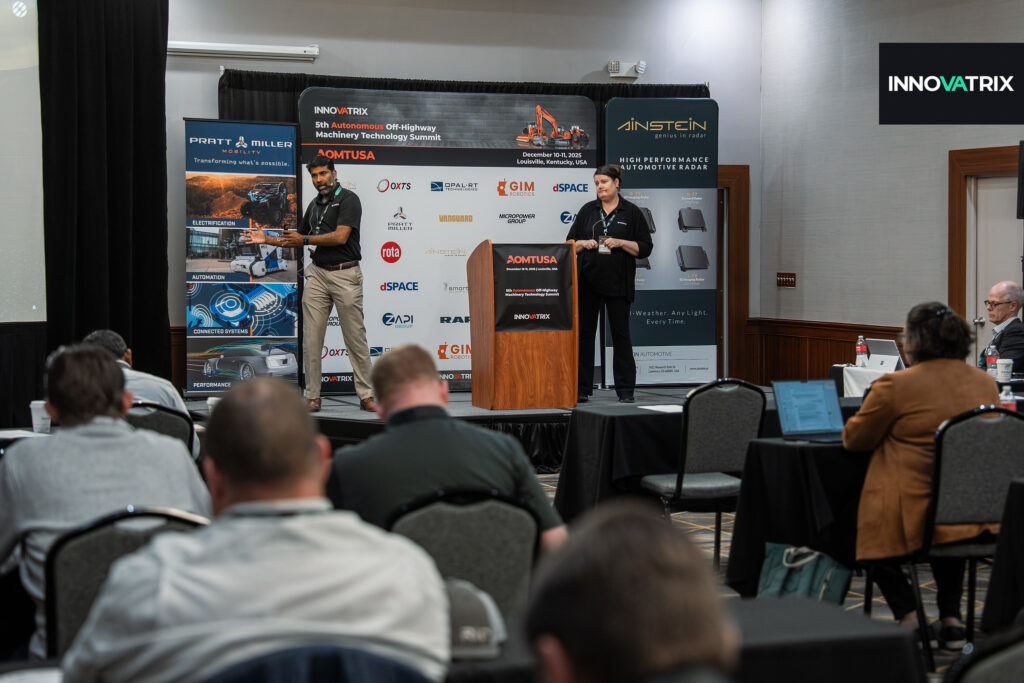
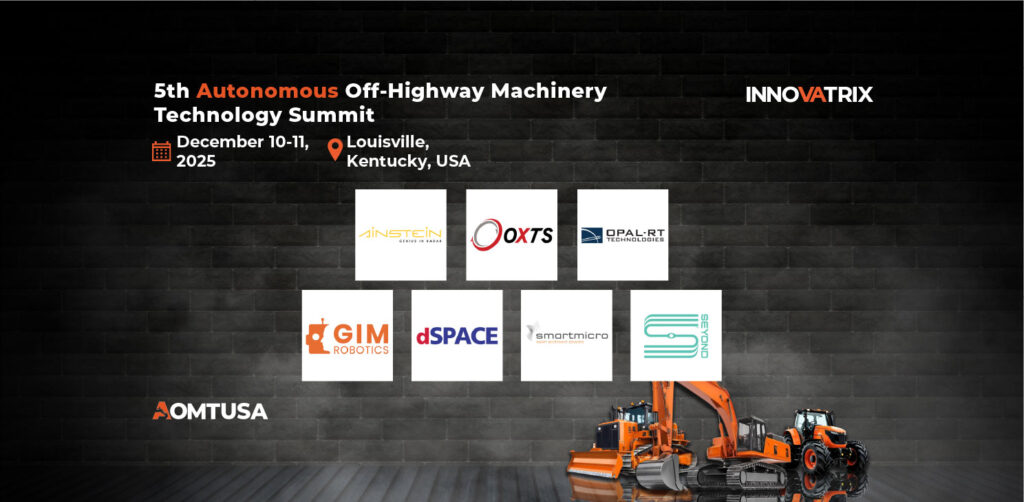
The 5th Autonomous Off-Highway Machinery Technology Summit was supported by a wide range of sponsors who brought their teams to our exhibition hall, and Innovatrix would like to thank them again for their support.
Ainstein AI, OXTS, Opal-RT Technologies, GIM Robotics, dSPACE, smartmicro, and Seyond.
If you want to attend our next autonomous off-highway summit and have the opportunity to hear presentations like these and many more, join us for our American edition this December. To discover the latest innovations and trends in robotics and autonomous off-highway machines, meet with solution providers and hear talks from industry leaders, register for the 7th Autonomous Off-Highway Machinery Technology Summit!
For more information, visit our website or email us at info@innovatrix.eu for the event agenda. Visit our LinkedIn to stay up to date on our latest speaker announcements and event news.