NVIDIA is making a new push to change how AI data centers are built, introducing a factory-integrated infrastructure model intended to move much of the complex work of assembling, connecting and validating high-density computing systems away from construction sites and into manufacturing facilities.
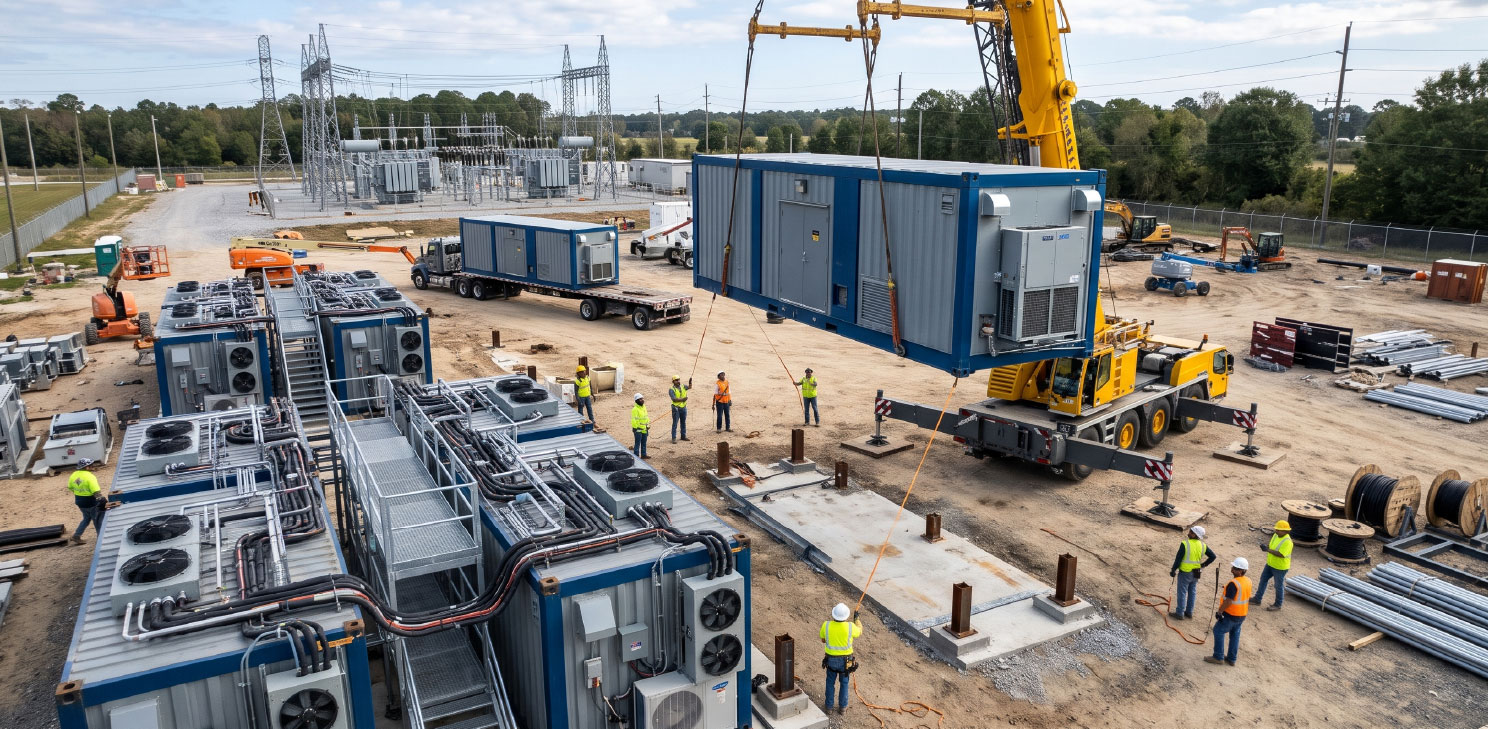
Unveiled October 21 at GTC Berlin, the company’s new DSX POD reference design is designed around the NVIDIA Vera Rubin platform and packages computing, networking, rack-level power and liquid cooling inside standardized modular containers. Rather than bringing those systems together through successive stages of onsite installation, participating manufacturers would complete integration, cabling, piping and functional testing before shipment.
NVIDIA claims the approach could reduce deployment time at a suitably prepared site from six months to as little as 14 days, allowing operators to begin generating production AI tokens and earning revenue substantially sooner. A global partner ecosystem is preparing to deliver the systems beginning in early 2027.
“An AI factory creates value when it starts producing tokens — not when construction is complete,” said NVIDIA founder and CEO Jensen Huang.
The announcement arrives as operators face mounting pressure to bring increasingly power-dense AI infrastructure online while managing skilled labor shortages, long construction schedules and rapidly changing hardware requirements.
But the larger development is not simply NVIDIA’s two-week deployment target. Separate announcements from its infrastructure partners reveal an increasingly substantial industrial base taking shape around standardized, factory-manufactured AI capacity.
From Crusoe’s new modular manufacturing facility in Colorado to Schneider Electric’s expanding prefabrication capacity, Armada’s proposed 500 MW sovereign AI infrastructure program and Vertiv’s work on a 41 MW deployment in Norway, the common objective is to make AI infrastructure delivery more repeatable, predictable and less dependent on assembling every system from scratch in the field.
Modular construction has been one of the defining trends of the AI data center buildout, as developers look for ways to accelerate deployment while managing increasingly complex, power-dense infrastructure. What makes NVIDIA’s DSX POD announcement potentially consequential is the scale of the proposed standardization. The ambition is no longer simply to manufacture electrical rooms, cooling systems or other infrastructure components offsite, but to deliver the AI factory itself as a repeatable, factory-integrated product.
The emerging model does not eliminate the need for conventional data center development. It does, however, propose a significant reorganization of where—and when—the most intricate infrastructure integration work gets done.
NVIDIA outlines how its DSX platform integrates computing, power, cooling and infrastructure simulation, with DSX POD extending the architecture into factory-built, containerized AI factories. (Source: NVIDIA)
The underlying engineering proposition is straightforward: as AI computing becomes more complex, particularly with the adoption of rack-scale liquid-cooled architectures, traditional methods of assembling and integrating equipment onsite introduce scheduling risks that become increasingly consequential.
Electrical infrastructure, cooling distribution, networking, racks and compute hardware must operate as an integrated system. Delays or design changes in one discipline can affect multiple others.
DSX POD is intended to address that coordination problem by establishing a repeatable, validated architecture that manufacturers can assemble and test in controlled environments while site preparation proceeds separately.
Importantly, DSX POD is distinct from NVIDIA’s broader Vera Rubin DSX AI Factory reference design, introduced in March. That design provides a facility-wide architectural framework encompassing compute, networking, storage, electrical distribution, cooling, controls and the engineering systems required to operate an AI factory. The larger DSX platform also incorporates simulation, infrastructure orchestration and software for optimizing computing output within available power budgets.
NVIDIA’s recently introduced DSX Ready qualification program extends that standardization effort to battery energy storage and liquid-cooling equipment, establishing technical requirements for the infrastructure supporting AI computing.
DSX POD translates those principles into a specific physical delivery model: containerized Vera Rubin AI factories assembled, integrated and validated offsite, then connected to prepared power, cooling and networking infrastructure. It is an extension of the broader DSX architecture, not a replacement for the site and facility systems that support it.
The company’s partner roster includes Dell Technologies, HPE, Lenovo, Bull, Foxconn/Ingrasys, Quanta Cloud Technology, Wistron, Pegatron, GIGABYTE, Schneider Electric, Vertiv, Eaton, Delta, Crusoe, Armada, DayOne and Anduril.
The breadth of that ecosystem is central to the strategy. Bringing a complete AI factory into production requires much more than shipping GPUs. It requires manufacturers capable of standardizing the electrical, thermal, structural and computing interfaces surrounding those systems.
Schneider Electric and Compass Put Numbers Behind Prefabrication
While NVIDIA’s two-week deployment target remains to be demonstrated at commercial scale, Schneider Electric has released more concrete evidence of the potential labor and installation savings associated with prefabricated infrastructure.
At GTC Berlin, Schneider introduced its RapidScale Modular Data Center Reference Design 115, a high-density architecture supporting the NVIDIA Vera Rubin platform and integrating power, liquid cooling, IT infrastructure and lifecycle services.
The company describes the design as an initial step toward supporting DSX POD, rather than a completed deployment of the NVIDIA containerized architecture.
More significant from an operational standpoint is a time study jointly developed with Compass Datacenters, examining the installation work that can be eliminated when high-density white-space infrastructure is assembled and tested before arriving at the data center.
The study compared a conventional installation sequence with prefabricated IT pods incorporating power distribution, cooling piping, containment and cable pathways. Conventionally, those systems require separate onsite installation activities, often involving multiple specialized trades working within the same constrained space.
At a Compass hyperscale campus, moving those activities into factory assembly reduced the measured onsite installation time from 75.5 hours using conventional methods to approximately 15 hours per prefabricated pod—an 80% reduction.
The savings came primarily from eliminating or consolidating field activities, rather than crews performing the same work faster. The study also documented improvements through repetition, with installation time declining from 18 hours to 15 hours as crews gained experience.
Those figures do not represent an 80% reduction in total data center construction time. They measure a specific portion of the installation process. Still, the findings offer useful evidence that factory integration can materially reduce the coordination demands and labor requirements of high-density construction.
Manufacturing scale is another part of Schneider’s argument.
The company reports that its modular infrastructure manufacturing capacity has increased fourfold since 2025. Its primary manufacturing footprint now encompasses eight sites totaling approximately 1.35 million square feet, supplemented by three additional company facilities and 12 partner sites across 10 countries.
Schneider says its RapidScale solutions incorporate approximately 90% internally manufactured equipment, positioning the company to manage a larger share of the infrastructure supply chain directly.
These investments suggest that prefabrication is evolving from an alternative construction method into a core manufacturing strategy for large AI infrastructure suppliers.
Virtual Twins Extend the Factory Model Into Engineering
Factory integration is only one part of the proposed transformation. Suppliers are also attempting to standardize the engineering and validation processes that precede manufacturing.
On October 22, Dassault Systèmes and Vertiv announced a collaboration to use Dassault’s 3DEXPERIENCE platform and virtual-twin technology to configure, simulate and validate AI factory infrastructure before construction.
The companies are combining Vertiv’s pre-engineered power and cooling systems with NVIDIA’s DSX AI Factory reference designs and Omniverse DSX Blueprint.
The objective is to model interconnected computing, electrical, thermal, networking and control systems within a common engineering environment, allowing changes in equipment configuration or operating requirements to be evaluated before they become field installation problems.
The collaboration extends work involving Vertiv’s SmartRun configurable virtual twin to broader infrastructure offerings, including its OneCore integrated data center platform.
The larger implication is that industrialized AI infrastructure requires more than standardized equipment. It also requires repeatable methods of configuring, testing and modifying interconnected systems for different sites, preserving design integrity from manufacturing through commissioning and subsequent technology upgrades.
To find out more about the latest industry updates and innovations in prefabrication for mega facility construction, meet with solution providers and hear talks from expert speakers, attend the Prefabrication for Mega Facilities Summit USA, taking place November 17-18, 2026, in Houston, Texas, USA
For more information, click here or email us at info@innovatrix.eu for the event agenda. Visit our LinkedIn to stay up to date on our latest speaker announcements and event news.
Source: