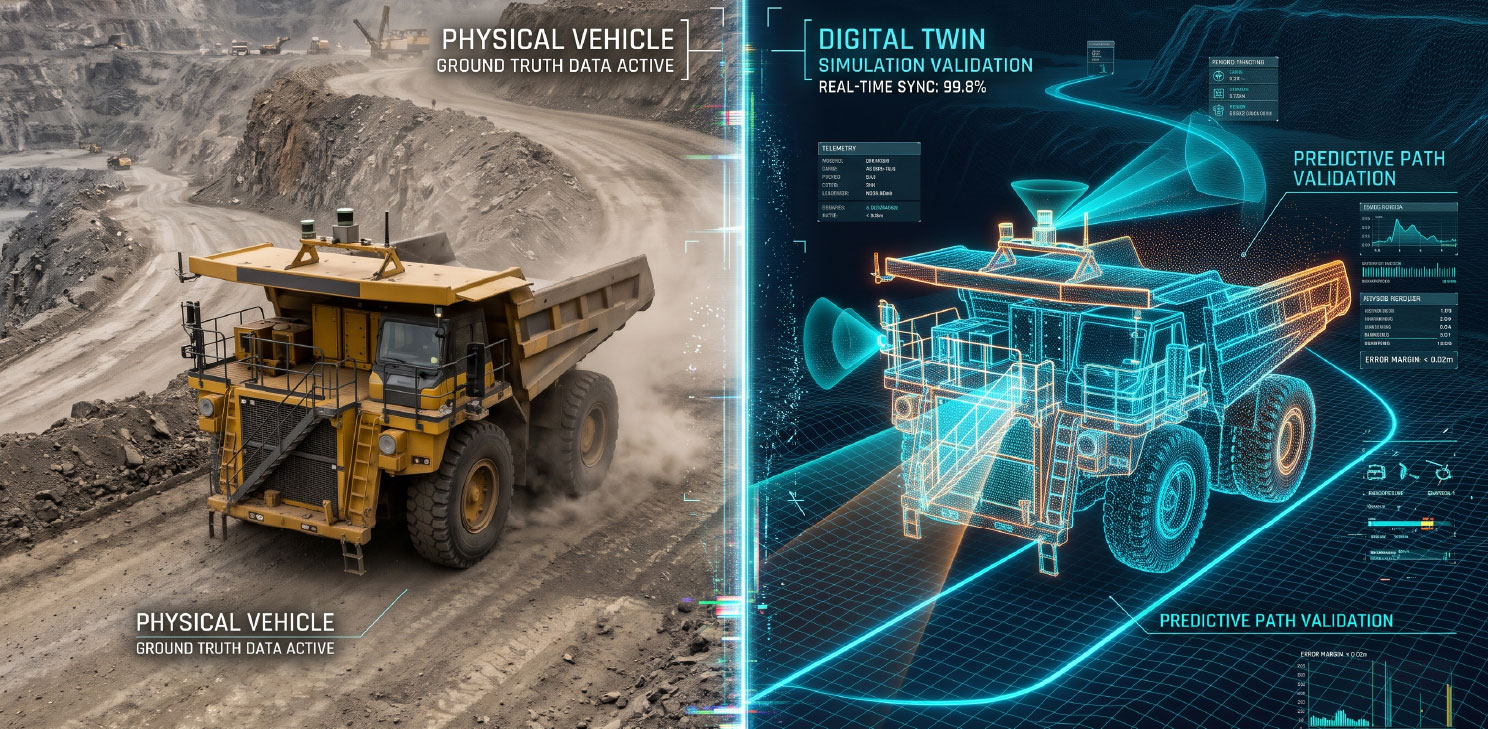
Real-world testing of autonomous machines is expensive, hard to replicate, time-consuming, and potentially dangerous. Digital twins offer a faster, safer path, but only if they behave like the real machine. That is the purpose of digital twin validation for an autonomous off-highway vehicle: confirming that simulated outputs closely match the real system.
Why Digital Twin Validation Matters
One RAND estimate suggests proving an autonomous system safer than a human driver on public roads would take around 150 million miles, so testing is moving into data centers. Unlike a one-off simulation, a digital twin is continuously fed with real data. One industry guide calls model validation the most crucial step. Snowflake notes that more thorough validation and verification can speed certification, and regulators are increasingly open to simulation evidence when a twin faithfully represents real behavior.
Validating the Hydraulics: A 10-Tonne Forestry Example
Researchers at Luleå University of Technology built a real-time multi-physics twin of AORO, a 10-tonne forestry research vehicle. It ran in real time with a 1 ms main time step and a 33 µs hydraulics step on a 2020 workstation.
The team validated the articulated joint by comparing flow rates against the physical vehicle at 100%, 75%, and 50% turning speed. Datasheets did not match observed behavior: measured mean flows were 70.6 and 65.4 L/min versus 62 and 61 L/min listed, so the team calibrated to measurements. Steady-state flow landed within 0.35% at full speed, 2.65% at 75%, and 6.44% at 50%.
Remaining differences hinted at possible air in the hydraulics and higher turning resistance. Adjusting the oil bulk modulus (equivalent to roughly 1% air) and disc brake force improved agreement. The authors treat these as hypotheses.
Scaling Digital Twin Validation for an Autonomous Off-Highway Vehicle
Researchers from Clemson University and the U.S. Army DEVCOM Ground Vehicle Systems Center paired a Polaris RZR twin with a cloud HPC cluster. They tested vision-guided emergency braking across four perception models, eight weather conditions, and four times of day: 128 test cases.
The sweep finished in under 1.33 hours versus over 10.66 hours sequentially, a sevenfold reduction. YOLOv3 performed best at 71.86%, while the tiny variants lagged, pinpointing perception weaknesses.
Closing the Loop Between Virtual and Physical
Volvo Autonomous Solutions uses closed-loop Software-in-the-Loop and Hardware-in-the-Loop testing. Mismatches between real and virtual runs expose weaknesses. Volvo also cautions that passing 99% of simulations builds confidence but does not guarantee real-world success. Luleå plans Vehicle-in-the-Loop tests at the NUVE-LAB in Oulu, Finland, while Snowflake points to generative AI for scenarios beyond recorded data.
Beyond the Vehicle: Digital Twin Validation in Supply Chains
Concordia University researchers used anyLogistix and a hybrid simulation approach to model a yogurt supply chain with autonomous trucks. A full autonomous fleet raised profit about 20%, cut transportation cost nearly 40%, improved lead times 33%, and reduced CO2 by 10%.
The authors are candid about validation limits. Their model relies on static or semi-dynamic data, so it is closer to a simulation-based digital model than a fully synchronized twin. They say empirical pilot testing is still needed.
Challenges to Plan For
Digital Divide Data highlights uncertainty analysis across sensor data, validation at both system and subsystem levels, and combining expert knowledge with data. PTV’s Seoul-based user, the Institute of Vehicle Engineering, notes that accurate virtual environments demand meticulous detail. Luleå found sensor noise limited how deeply flow curves could be analyzed.
Conclusion
Digital twin validation for an autonomous off-highway vehicle works best as a loop: calibrate to measurements, test at scale, compare with reality, and investigate every mismatch. Simulation does not replace physical testing, but it focuses and accelerates it.
To learn more about the future of autonomous off-highway vehicles, hear keynote speeches about the latest innovations in the field, and visit a wide array of exhibitors, book your place to attend the 7th Autonomous Off-Highway Machinery Technology Summit, taking place March 10-11, 2027, in Chicago, Illinois.
For more information, visit our website or email us at info@innovatrix.eu for the event agenda. Visit our LinkedIn to stay up to date on our latest speaker announcements and event news.