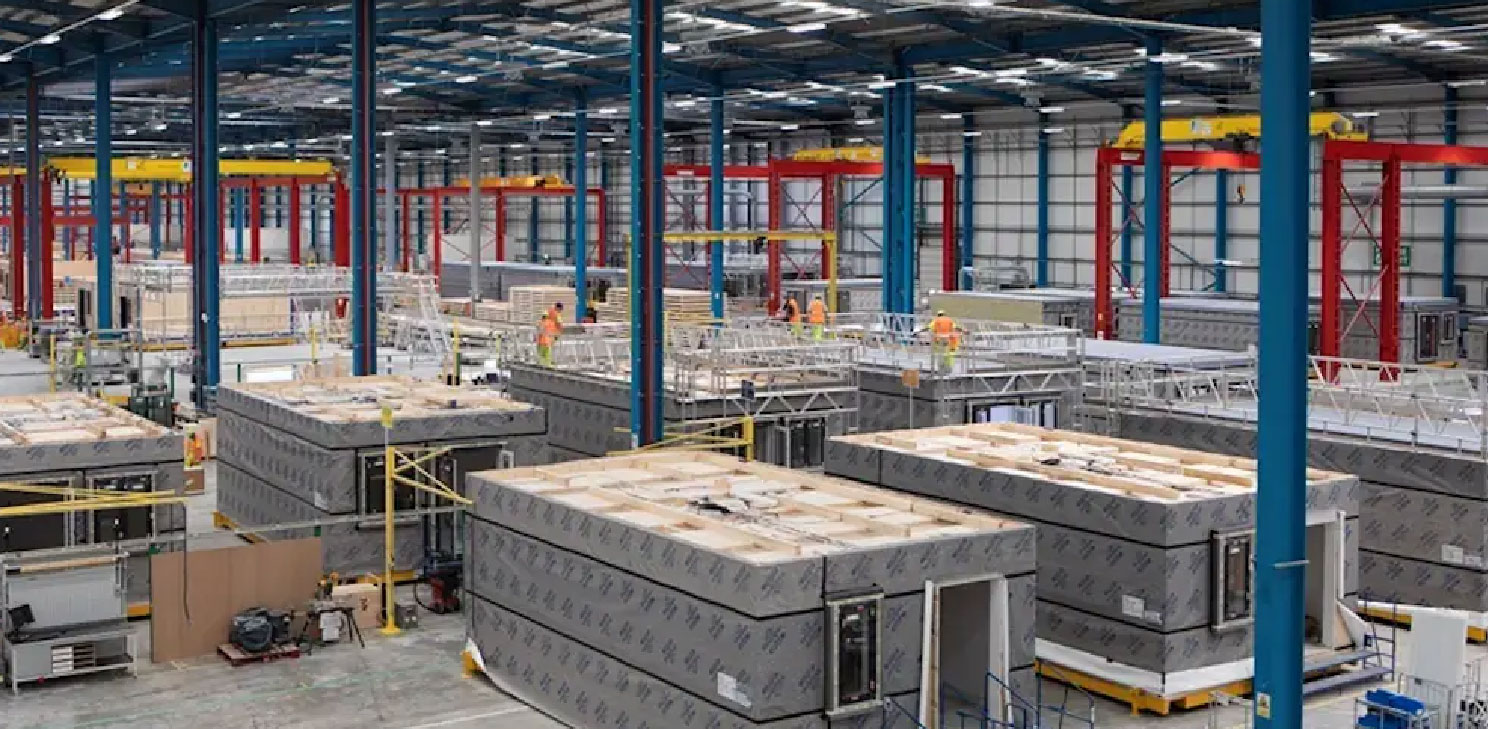
The 5th Battery Gigafactory Summit USA: Advances In Planning, Engineering And Operations took place from March 11-12, 2026, at the Holiday Inn & Suites Phoenix Airport Northin Phoenix, AZ, USA. The summit brought together industry leaders, engineers, decision-makers, and technology innovators who are driving the evolution of gigafactory design, engineering, and operations.
Attendees gained valuable insights into the importance of advanced planning, sustainable construction, and optimized operations across the entire battery production value chain.

This article will provide a session recap for those who didn’t get the chance to attend and serve as a reminder for those who attended.
Quality Is Yield: The Real Driver of Gigafactory Growth
Dr. Jennifer Alkhalil, Quality Planning Manager at Volkswagen Group of America – PowerCo US

Jennifer explained that quality is the fundamental driver of gigafactory yield, growth and profitability. A factory producing 20 GWh annually could generate around $100 million in additional revenue by improving yield from 92% to 97%, highlighting the financial importance of quality from the earliest planning stages.
She emphasised that quality considerations should begin with the first factory design, particularly by defining ISO debris and contamination requirements. Different production areas may require different cleanliness standards, while physical separation between anode and cathode logistics and production areas can help prevent cross-contamination. Cleaning zones should also be designed according to VDA 19.2 principles.
Machine planning should account for cell-specific characteristics, online measurement requirements, surfaces, lubricants and conveyor designs that minimise debris. Supplier evaluation should cover quality, financial stability, compliance, sustainability, risk and operational performance.
Jennifer also highlighted the importance of rigorous incoming inspection, cross-functional alignment and FMEA across design, process and system levels. A robust control plan linked to SPC and PFMEA can accelerate yield improvements significantly. She concluded that continuous improvement strengthens quality, reduces costs, improves safety and builds resilience, making quality everyone’s responsibility.
Adapting to Change: Dry Room Strategies for Evolving Battery Chemistries
David Yates, Vice President, and Drew Overmiller, Vice President | Director of Engineering & Planning, at JE Dunn Construction

David and Drew highlighted the critical role of dry rooms in battery manufacturing, where design decisions can directly affect project schedules, throughput and cell performance. As battery chemistries evolve and procurement conditions remain volatile, dry rooms must be designed to accommodate changing requirements rather than relying on fixed assumptions.
They discussed common causes of inadequate moisture control, including undersized or ageing desiccant systems, poor air circulation, frequent door openings and poorly positioned sensors. These issues can create gradual process drift that may not produce immediate failures but can significantly affect manufacturing performance over time.
Dry rooms combine principles from semiconductor cleanrooms, pharmaceutical and biotech facilities, aerospace and automotive manufacturing, requiring coordinated control of both moisture and contamination. Successful delivery depends on clear responsibility matrices and sequencing across design, cleanroom, HVAC, controls, testing and certification teams.
They also addressed brownfield conversion challenges, including ways to minimise structural modifications through innovations such as self-supporting roof structures. Typical requirements include ISO Class 5–6 for critical areas, ISO Class 7–8 for general areas, and dew points from -40°C to -50°C, with advanced chemistries potentially requiring -60°C to -100°C. Temperature stability is equally important for electrolyte performance, moisture control, fire risk and equipment effectiveness.
From China to Europe to the USA – Chinese Equipment: Risk or Chance
Tobias Frieser, Business Development Europe & North America at Pophen (L&B International)

Tobias examined the risks and opportunities of integrating Chinese equipment into European and U.S. manufacturing, arguing that country of origin should not be the primary procurement consideration. Instead, buyers should focus on predictable outcomes, compliance, continuity, accountability and total risk exposure.
He highlighted key challenges including geopolitical tensions, tariffs, export controls, supply dependence, service availability and compliance with local standards. Long-term production continuity requires responsive technical support, spare-parts availability, transparent documentation and clear accountability for specifications, certifications and performance.
Drawing on lessons from Europe, Tobias identified certification, transparency, local engineering expertise, hybrid supply chains and long-term partnerships as important factors in overcoming concerns about equipment origin. Chinese manufacturing can offer competitive pricing, rapid scaling and strong industrial capabilities when combined with local engineering and compliance expertise.
He emphasised that compliance can become a competitive advantage when international equipment is designed to meet U.S. requirements from the outset rather than being adapted later. Looking ahead, he advocated for multi-regional manufacturing, collaborative supply chains, standards-driven execution and trust-based partnerships. He concluded that Chinese equipment represents either a risk or an opportunity depending on how it is sourced, integrated and supported, with execution, compliance and trust ultimately determining the outcome.
Dry Room Design 101: Ensuring Peak Performance & Energy Efficiency
Keith Hoge, Business Development Consultant at Bry-Air (Asia) Pvt., Ltd.

Keith highlighted the dehumidifier as a major driver of energy consumption in battery cell production and emphasised the importance of considering dry room efficiency from the earliest stages of design. Three key factors influence energy use: desiccant reactivation, occupancy and fresh air requirements.
Reactivation requires thermal energy to dry desiccant media, typically using natural gas, steam or electricity. Occupancy also has a significant impact because people introduce additional moisture into the room. As occupancy increases, the dehumidification airflow required to maintain conditions rises, driving exponentially higher energy consumption. Similarly, increasing the proportion of fresh air requires the dehumidification system to perform more conditioning work, although positive room pressure helps prevent moisture and contaminants from entering.
Keith explained that lower dew point requirements further increase supply airflow and energy use. He recommended early collaboration between project owners, equipment providers and dehumidification specialists to establish realistic requirements for equipment exhaust, occupancy, dew point and ventilation.
He also stressed the importance of educating operators on gowning, occupancy limits and the effects of equipment or layout changes. As newer battery chemistries require increasingly dry environments, potentially reaching dew points as low as -80°C, energy-efficient dehumidification will become increasingly important.
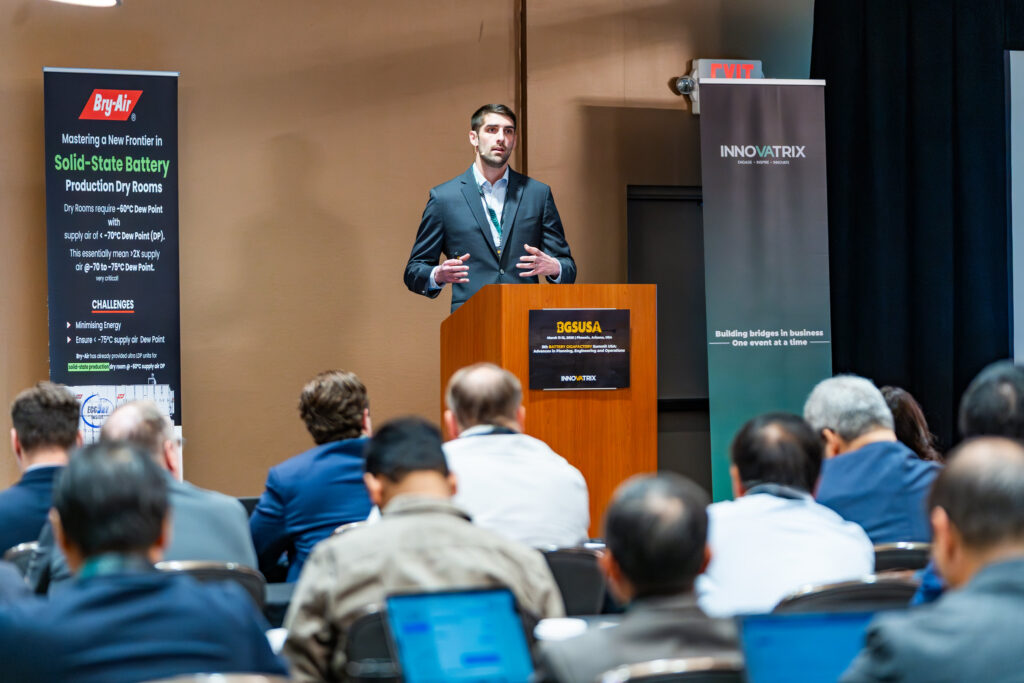
AI Orchestrated Battery Manufacturing: from 5M1E to MMM
Daniel Li, Managing Director at ManufAgent Solutions

Daniel explored how AI can transform battery manufacturing by connecting the traditional 5M1E framework of Man, Machine, Material, Method, Measurement and Environment into an integrated, self-learning manufacturing system. He explained that weaknesses in any pillar can create waste, delays and process drift, while aligning all six and standardising data can support the transition towards adaptive, digital-first operations.
Drawing on lessons from semiconductor manufacturing, Daniel highlighted the challenges facing U.S. gigafactories, including lengthy permitting processes, skilled labour shortages, limited contractor experience, environmental concerns, higher dry-room costs and immature domestic supply chains. Early gigafactories can experience yields of only 60–80%, demonstrating the importance of ecosystem maturity.
Daniel outlined how generative AI can enhance every element of 5M1E. AI copilots can support workers, predictive maintenance can improve equipment uptime, AI vision can strengthen material traceability and quality, digital twins can optimise processes, and intelligent data analysis can accelerate root-cause identification. AI can also optimise energy use and environmental performance.
He described a shift from efficiency-focused manufacturing towards agile, high-mix production, measured through Time, Volume, Yield and Cost. Ultimately, AI orchestrates machines, methods, measurement and environmental controls while humans provide innovation and governance, creating an adaptive cyber-physical factory.
Manufacturing of Semi/All-Solid-State Li-ion Batteries — from Laboratory Prototyping to Commercial-Scale Production
Timothy Lin, CTO of Solid Energies

Timothy examined the transition from conventional lithium-ion batteries towards semi-solid and all-solid-state technologies, highlighting their potential to improve energy density, safety, charging performance and temperature tolerance. Solid-state batteries could target 400–500 Wh/kg while replacing flammable liquid electrolytes with solid or semi-solid alternatives.
He positioned semi-solid batteries as a near-term bridge between conventional and fully solid-state technologies. They can use adapted lithium-ion manufacturing infrastructure, with around 90% equipment compatibility and roll-to-roll processing already demonstrated. Semi-solid cells can offer higher energy density, improved thermal stability, faster charging and longer cycle life, although yield must improve from around 80–90% to more than 95%.
All-solid-state batteries offer greater long-term potential but face significant manufacturing challenges, including solid-solid interface resistance, electrode volume changes, high-temperature processing, stringent defect control and material stability. Their equipment requirements can also cost four to five times more than conventional lithium-ion lines.
Timothy stressed the importance of pilot lines in bridging the gap between laboratory prototypes and commercial production, with more than 30 pilot lines operating globally. At least seven GWh-scale facilities are operating or being developed, signalling the beginning of mass production. He outlined a gradual market transition, with semi-solid technology scaling first before all-solid-state batteries expand from premium applications towards wider adoption.
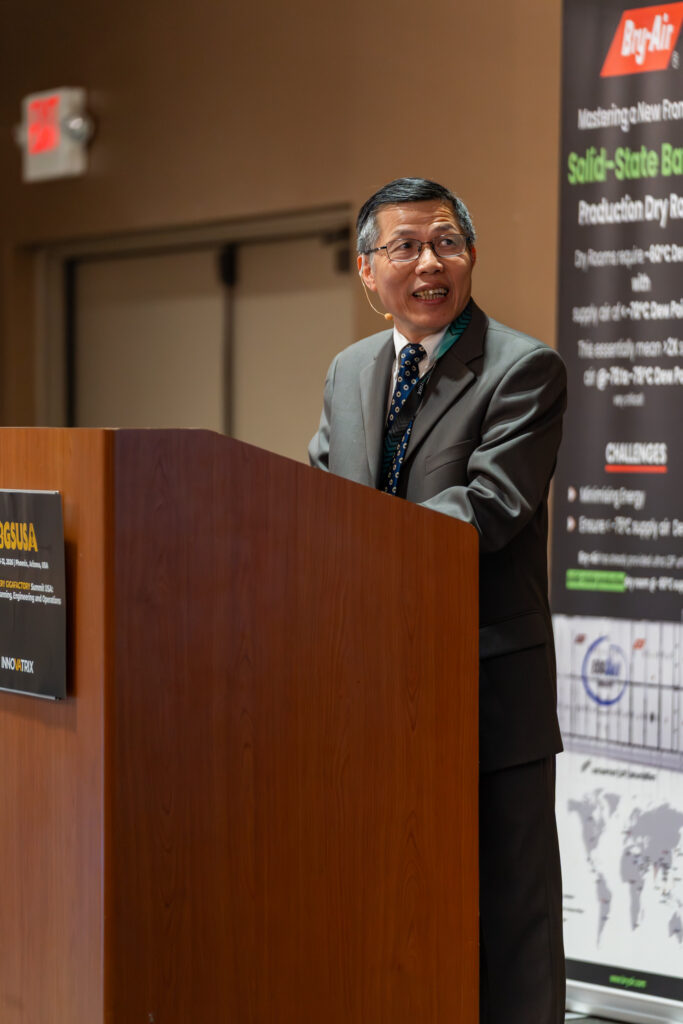
Industrial AI and the Future of Manufacturing
Shobhit Kamal, Founder & CEO of Factron AI

Shobhit explored how manufacturing is evolving as production increasingly moves towards lower-cost countries with abundant resources. He highlighted the challenge facing the US, arguing that bringing manufacturing back will require deep-tech innovation rather than reliance on labour arbitrage. Manufacturing has historically been slow to adopt new technologies, contributing to factory launches taking twice as long in the US compared with Asia.
He introduced Factron AI as a way to address these challenges by bringing greater intelligence into both existing and future factories. The presentation positioned industrial AI as the next major stage in manufacturing automation, building on decades of developments from relay panels and PLCs to cloud integration. Shobhit explained how Factron AI combines factory data, including information from PLCs, MES, SCADA, IoT sensors and other digital systems, to create a foundation of memory, context and awareness.
He demonstrated how this intelligence can support evidence-backed root-cause identification, analyse historical plant data and documentation, and identify logic and programming errors. The approach aims to reduce downtime, accelerate design cycles and make factories smarter, ultimately helping manufacturers launch new facilities and bring products to market faster.
Beyond the Gigafactory: Economical Multi-Variant Battery Manufacturing in the Age of Resilience
Christoph Baum, Program Director Battery Research at Fraunhofer USA

Christoph explored how battery manufacturing can move beyond the conventional gigafactory model to serve increasingly diverse markets requiring multiple cell variants, smaller production volumes and specialised performance. While automotive applications dominate global lithium-ion demand, niche markets such as UPS, telecoms, power tools, e-bikes, medical equipment and defence offer significant opportunities, particularly where resilience and supply-chain independence are priorities.
He highlighted defence as an important example, with growing efforts to reduce reliance on foreign battery supply chains and increasing interest in technologies such as lithium-sulfur, solid-state, nickel-zinc and flow batteries. These markets are highly fragmented, with numerous applications and battery technologies requiring flexible manufacturing approaches.
Christoph identified the “valley of death” between laboratory innovation and commercial production as a major challenge. Poor ramp-up performance, scrap and start-of-production delays can create substantial financial losses, while established market leaders can achieve target OEE significantly faster.
For niche and mid-volume applications, conventional gigafactory equipment may be economically unsuitable because of frequent changeovers and ramp-up requirements. Christoph proposed modular, highly automated and adaptable production systems with digitalisation and high-performance intralogistics. Matrix production, based on modular building blocks and identical production elements, could enable seamless transitions from pilot-scale manufacturing to medium and high production volumes while reducing scaling risks and costs.
Data-Driven Inverse Engineering of Water Treatment: Optimizing Membrane Design and WWTP Operation with Machine Learning
Nohyeong Jeong, Wastewater Treatment Plant Manager at Hyundai Engineering

Nohyeong argued that wastewater treatment should move from reactive management towards predictive, data-driven operation. The presentation demonstrated how machine learning and Bayesian optimisation can be applied both to membrane design and wastewater treatment plant operations.
For membrane development, Nohyeong contrasted conventional trial-and-error approaches with inverse design, where desired performance is defined first and machine learning is then used to identify membrane designs capable of achieving targeted salt rejection and water permeability. A training dataset drawn from published research was used to develop predictive models, followed by Bayesian optimisation and experimental validation. Although predictions were not perfectly accurate, they closely matched testing results.
Nohyeong emphasised that successful AI-assisted design depends on structured, representative and high-quality data, alongside clearly defined engineering targets. Domain expertise remains essential, particularly when selecting input variables and interpreting model results.
The same principles were applied to wastewater treatment plant optimisation. Operational inputs such as influent COD, heavy metals, flow rate, chemical dosage and retention time can be used to predict effluent quality, chemical consumption and sludge production. Bayesian optimisation can then identify operating conditions that reduce compliance risks, chemical overdosing and sludge disposal costs.
The approach demonstrates how AI can connect laboratory innovation with intelligent industrial operations while improving efficiency, compliance and resource use.
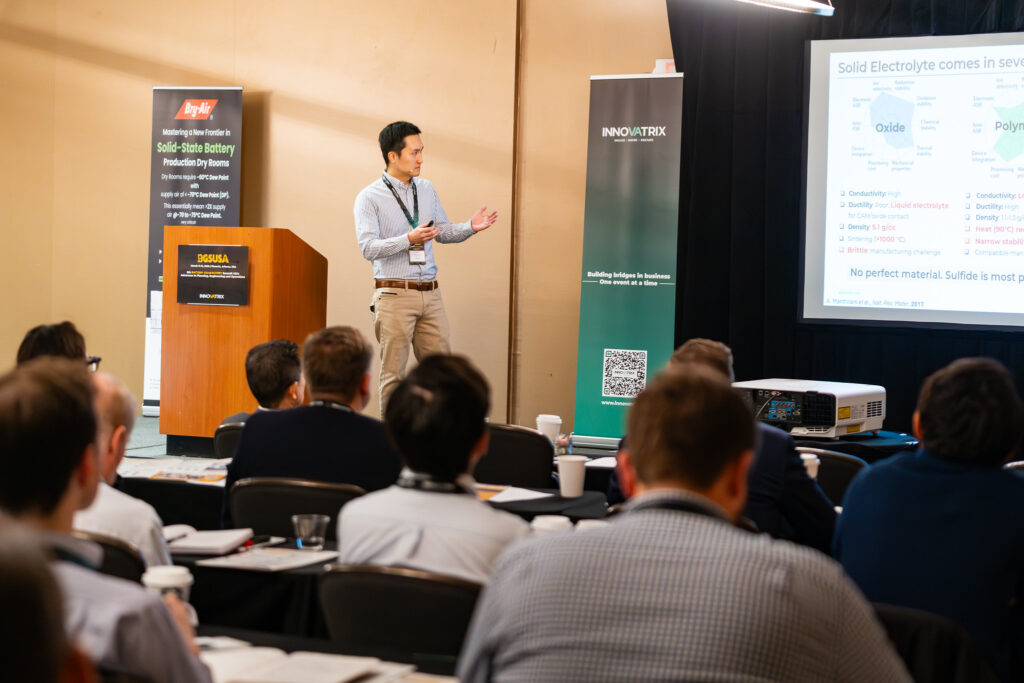
Beyond the Liquid: Mastering the Solid-State Shift
Eongyu Yi, Director of Battery Technology at Ampcera

Eongyu explored the potential of solid-state batteries to overcome key limitations of conventional lithium-ion technology, including energy density, safety, charging speed and temperature performance. Solid electrolytes enable high-capacity anodes and could support applications requiring greater energy, power and safety within a single cell design.
He compared oxide, polymer and sulfide solid electrolytes, highlighting the trade-offs between conductivity, ductility, density, processing requirements and stability. While no material is perfect, sulfides were presented as particularly promising because of their high conductivity, good interfacial contact and compatibility with existing manufacturing processes, despite their sensitivity to moisture and need for controlled stack pressure.
Eongyu described a solid-state cell using a high-loading, dry-processed NMC cathode, a thin sulfide separator and a high-silicon-content anode, targeting energy densities above 400 Wh/kg. Thermal management can enable rapid charging and cold-weather performance, while eliminating liquid electrolyte improves safety.
Importantly, sulfide solid-state batteries can retain significant manufacturing commonality with conventional lithium-ion production, including roll-to-roll coating, potentially reducing conversion costs. However, challenges remain around stack pressure, silicon volume changes, lithium dendrites, electrolyte cost and air sensitivity. Eongyu emphasised that manufacturing readiness, process optimisation and supply-chain collaboration will be essential to move sulfide solid-state batteries from promising technology to large-scale deployment.
From Schedules to Systems: Rethinking How Complex Projects Truly Move
Toshifumi Unno, Senior Manager – Program Management Office at Panasonic Energy Corporation of North America

Toshifumi challenged the assumption that having a detailed project plan is enough to ensure successful delivery. He argued that complex projects often fail because the mechanisms supporting delivery have not been redesigned to match new organisational structures, incentives and relationships.
He highlighted that delays are frequently caused not by the duration of individual tasks but by “stops” at interfaces between construction, equipment and manufacturing teams. Unclear specifications, schedule misalignment, access constraints and quality validation can create significant friction, meaning the gaps between teams can be more problematic than individual capability.
Toshifumi also distinguished between progress and readiness, noting that completing an activity does not necessarily mean the next stage is prepared to proceed. Similarly, recovery plans can create a false sense of control when they rely on theoretical possibilities rather than realistic conditions.
He proposed shifting project management away from simply tracking dates towards managing the conditions required for progress. Governance should establish a single source of truth that enables rapid decision-making rather than focusing primarily on reporting.
He concluded that complex projects need a system for sensing site reality, rapidly transmitting information, processing it through both data and human judgement, and enabling organisations to act quickly and safely. At the centre of this system are people, whose collaboration and decision-making ultimately determine project success.
Connecting the Dots: Using BIM and VDC on large manufacturing facilities
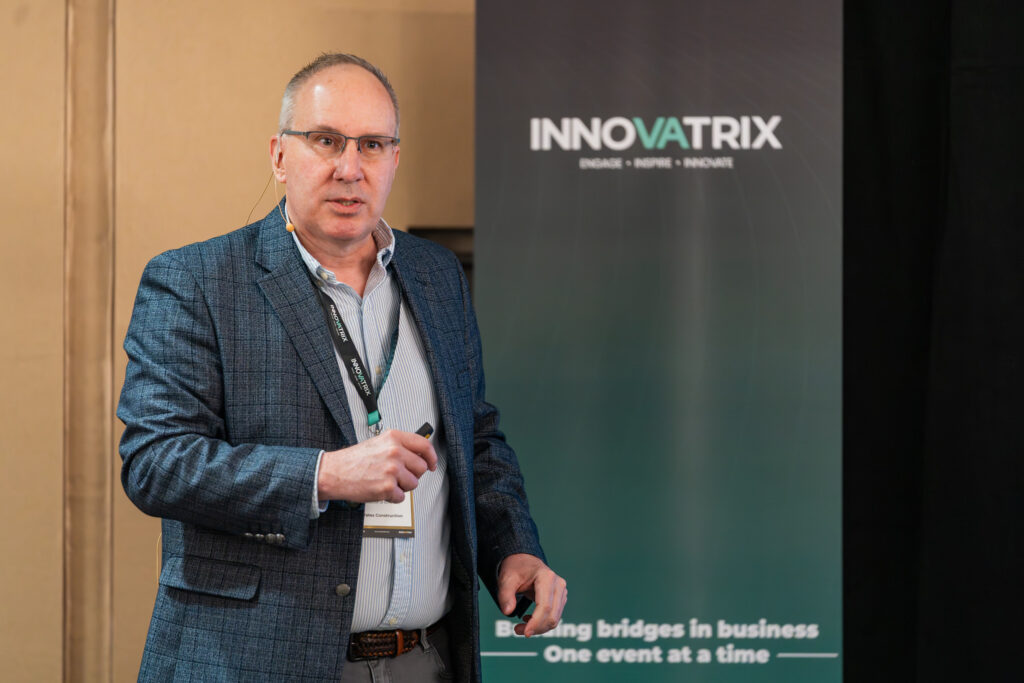
Greg Smith, Director of BIM/VDC at Yates Construction

Greg explored how BIM and VDC can connect information and workflows across the design and construction of large manufacturing facilities. He described the purpose of VDC as delivering the right information to the right person at the right time for the right task, while making that information as accessible and usable as possible.
He demonstrated how connected workflows can allow designers, estimators and construction teams to work from shared model information, improving quantity verification, estimating and coordination. A clear BIM Execution Plan is essential for establishing how information is shared, where data is stored and how files are named and managed throughout the project.
Greg highlighted the significant cost of poor project information and communication, noting that they contribute substantially to rework. He argued that decisions about sharing and relying on models must be clearly defined in project documentation, with responsibilities for model quality established from the outset.
When project information is not shared effectively, errors, misunderstandings, risk, rework and costs increase for all parties. By contrast, connected information reduces these issues and supports more efficient delivery.
He emphasised the importance of learning from projects where things go wrong, particularly around design and construction sequencing and model coordination. Ultimately, BIM and VDC provide a framework for connecting information across the journey from design through construction to operations.
Lithium Metal Batteries at Gigafactory Scale: Aligning Electrolyte Innovation with Manufacturing Reality
Lily (Zhaohui) Liao, Senior Manager of Data Analytics & Electrolyte at Sion Power Corp.

Lily examined the potential of lithium-metal batteries to deliver energy densities exceeding 400 Wh/kg and 900 Wh/L, making them attractive for aviation and other weight-constrained applications. Advances in electrolyte design, interphase control and cell architecture are enabling this technology while retaining elements of the existing cathode and manufacturing ecosystem.
She compared advanced liquid electrolytes with solid-state systems, explaining that both address interfacial instability but place control challenges in different areas. Liquid systems rely heavily on chemical formulation and dynamic interphase management, while solid-state systems depend more on mechanical contact, geometry and environmental control.
Lily emphasised that the key performance indicators change as technology scales. Laboratory development focuses on metrics such as Coulombic efficiency and ionic conductivity, while prototypes prioritise durability, thermal response and safety. At gigafactory scale, yield sensitivity, process-window width and throughput become critical, with statistical reproducibility replacing peak electrochemical performance as the priority.
Manufacturing-ready electrolytes therefore require co-design across materials, process integration, data infrastructure and factory architecture. AI and machine learning can translate process variability into actionable control variables and yield-predictive maps.
She concluded that lithium-metal adoption is not simply a chemistry decision but a manufacturing and capital-allocation strategy. Liquid and solid-state approaches distribute risk differently, and successful gigafactories must simultaneously optimise energy density, yield stability and capital efficiency.
Successfully Engagement with Local Fire Departments
Kathleen McCaffery, CEO of McCaffery Consulting and Training, LLC, representing Intertek-CEA

Kathleen highlighted the growing importance of engaging local fire departments early when developing industrial facilities, particularly as fire authorities face increasing pressure from local communities and policymakers. Delays, additional study requests and evolving legislation can significantly increase project costs and timelines, while several U.S. states have introduced requirements for engagement with local fire departments.
She emphasised that authorities having jurisdiction have considerable discretion when determining whether safety requirements are met. Rather than waiting for formal code enforcement processes, project teams should establish relationships with fire department operations personnel early, invite them to collaborate and provide training tailored specifically to the fire service.
Kathleen explained that project teams should identify the correct fire department contacts across the inspection, operations and investigation functions. Inspection personnel address permits, hazardous materials, fire-code compliance and system inspections; operations teams focus on emergency response, incident command, pre-planning and site walkthroughs; and investigation teams handle fire-cause determination and major incidents.
Early engagement can reduce project pushback, provide valuable site-safety recommendations and help responders understand facility operations before an emergency occurs. Familiarity with the site can improve emergency response efficiency, support emergency response planning and strengthen coordination between stakeholders.
Kathleen concluded that fire department engagement should be viewed as a proactive safety partnership rather than simply a regulatory requirement, helping protect people and property while reducing operational and project risks.
5th Battery Gigafactory Summit Sponsors
The 5th Battery Gigafactory Summit USA: Advances In Planning, Engineering And Operations was supported by Bry-Air and Pophen who brought their teams to our exhibition area, and Innovatrix would like to thank them again for their support.

If you would like to network with fellow experts and innovators from across the battery manufacturing industry and be informed on the latest innovations in gigafactory construction, join us at an Innovatrix conference today! Our next edition of the Battery Gigafactory Summit will be taking place later this year on November 18-19, 2026, in Nashville, Tennessee, USA.
For more information, visit our website or email us at info@innovatrix.eu for the event agenda. Visit our LinkedIn to stay up to date on our latest speaker announcements and event news.