The Pre-construction for Mega Facilities Summit USA took place from 10–11 February, bringing together attendees from across the mega facility construction industry at the Hilton Austin Airport Hotel. The two-day preconstruction event will bring together industry leaders, contractors, designers, engineers, owners, and technology innovators to explore innovative strategies for large-scale project delivery.
Our attendees gained insights into cutting-edge approaches like early collaboration, Design for Manufacture and Assembly, and digital workflows. These strategies are enhancing project efficiency and driving innovation across a variety of industries, ensuring that mega facilities can be delivered on time and within budget.

This article will provide a session recap for those who didn’t get the chance to attend and serve as a reminder for those who attended.
Engineering the first 100 days: A Digital Twin Approach
Siddharth Kothari, Director, Digital Engineering at Suffolk Inc.

Siddharth highlighted the importance of the first 100 days of a construction project in establishing a strong foundation, as early decisions can become difficult to reverse and have significant contractual and financial implications. He positioned digital twins as dynamic project representations that integrate data across the lifecycle, helping teams improve efficiency, make informed decisions and mitigate rather than transfer risk.
The approach begins on Day Zero, with funding, design teams, contractors and key vendors selected, alongside a suitable contractual framework. The desired outcomes include greater cost certainty, schedule optimisation, mitigation of unknowns such as existing conditions and utilities, and a smoother transition into operations.
Days 1–10 focus on stakeholder alignment, defining objectives and KPIs, establishing modelling standards, assessing team capabilities, and creating consistent work and cost breakdown structures. Days 10–30 develop the digital twin, visualise design intent, and establish integrated data flows between models, schedules and costs. Days 30–50 focus on risk assessment, mitigation and recurring reality-capture workflows.
From Days 50–100, dashboards monitor project progress and KPIs, enabling cross-disciplinary communication and data-driven decision-making.
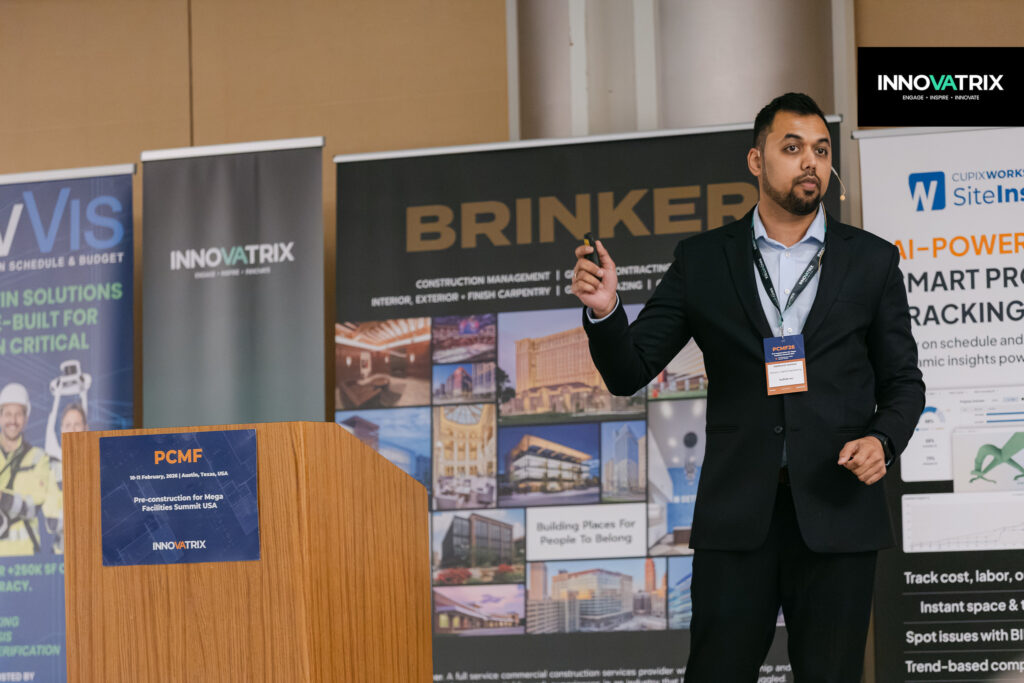
Building with Foresight: Portfolio Intelligence for the Modern Contractor
Steve Dell’Orto, Founder and CEO at ConCntric
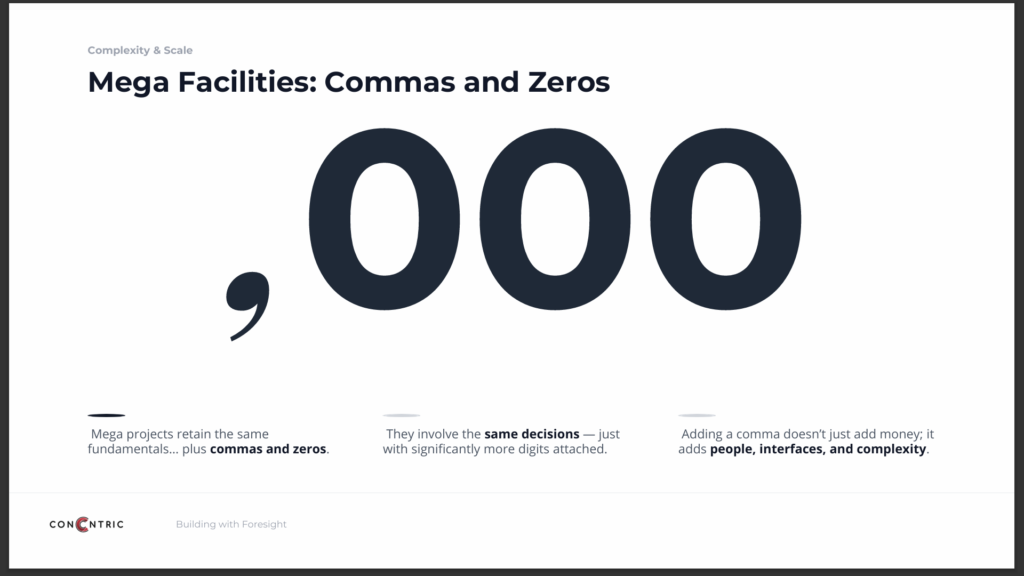
Steve explained that on mega projects, coordination often fails before the physical work does, as increasing numbers of stakeholders, communication channels, decisions and changes create a complexity multiplier. Early ambiguity becomes increasingly costly as volatility, long-lead packages, specialised trades, supply-chain challenges and commissioning requirements amplify the consequences of poor assumptions.
He described Portfolio Intelligence as using institutional experience to improve current and future projects, supported by an operating system capable of managing thousands of decisions, costs and outcomes that cannot be retained through memory alone. This enables contractors to allocate preconstruction talent according to portfolio priorities, identify resource conflicts and bring specialists into projects earlier.
Shared visibility, standardised information exchange and technology-enabled collaboration can reduce silos, communication distortion and version-control issues. Steve emphasised using comparable projects, benchmarking and forecasting to improve early assumptions, identify hidden cost drivers and anticipate staffing, procurement and commissioning conflicts.
He also highlighted that project drift cascades across schedules, procurement and commissioning, making early constraint alignment and data-backed contingencies essential. For owners, this means broadening success measures beyond cost to include risk, ROI and external factors, while demanding structured technology platforms rather than fragmented spreadsheets and files.
The Preconstruction Playbook for Mega Healthcare Campuses: Managing Complexity, Stakeholders, and Cost Certainty at Scale
Khristina Stone, Preconstruction Manager at Hensel Phelps

Khristina outlined three imperatives for managing complexity and achieving cost certainty on mega healthcare campuses: stakeholder alignment, early decision-making and transparent cost management.
She explained that competing priorities between clinical teams, owners and facilities groups can create paralysis when there is no clear mechanism for resolving disagreements. A three-tiered structure of weekly user group meetings, super user groups with decision-making authority and an executive steering committee created clear decision lanes, transparent trade-offs and accountability without escalating every issue to senior leadership.
Timing was equally critical. Decisions affecting multiple building systems or campus-wide performance should be made during schematic design, including sustainability commitments, structural performance, equipment selection and programme requirements. Late decisions can trigger redesign, schedule pressure, unplanned costs and stakeholder friction.
For cost certainty, Khristina advocated detailed bottom-up estimates, live costing during client meetings, transparent trend logs and full estimate updates at each design milestone. Early trade buyout was particularly valuable, bringing major subcontractors into design to provide real market pricing and constructability input. By GMP submission, this approach had captured 75% of project costs with actual trade partners, shifting the process from simply estimating to contracting.
Ultimately, transparent and reliable cost information builds owner trust and enables more confident project decisions.
Optimizing Mega-Facility Pre-Con and Civil Works with End-to-End Spatial Intelligence
Varsha Khemka, Customer Success Manager at Cupix
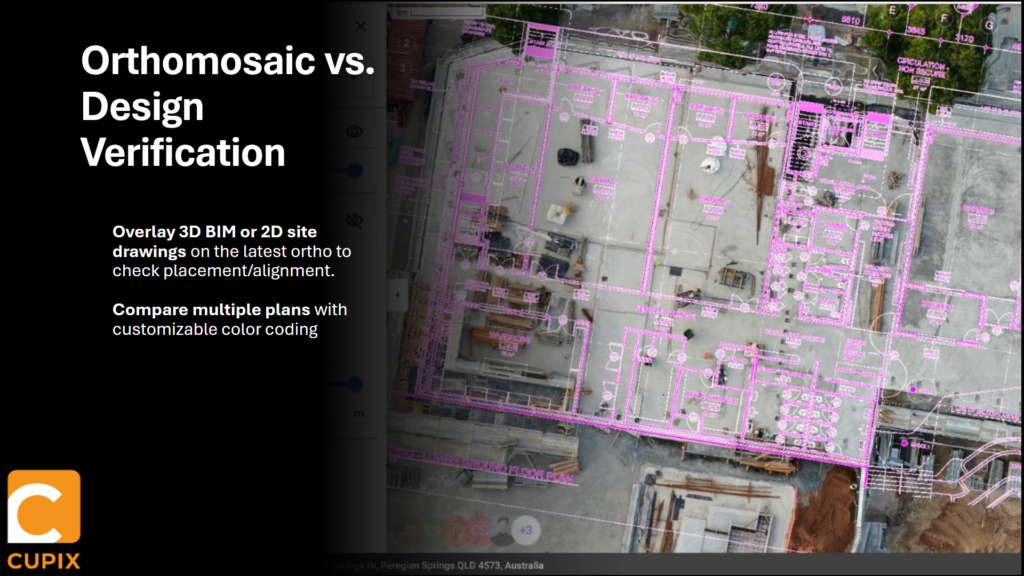
Varsha highlighted how preconstruction can determine the outcome of mega-facility projects, where aggressive schedules, large campuses, dense MEP systems, parallel indoor and outdoor works, and commissioning pressures demand engineering-grade certainty rather than basic status updates.
She explained that true 3D geometry provides the foundation for spatial intelligence. Point-cloud models enable accurate measurements and validation of site work, earthworks, stockpiles, utilities, ceiling heights, rack clearances and MEP routing. Unlike photographs and video, measurable 3D reality allows teams to verify whether installed conditions match plans and designs.
BIM-aligned progress tracking further strengthens this approach by comparing point-cloud geometry with BIM and imagery, allowing progress to be monitored by system, zone and schedule. Drone-based orthomosaics can be integrated with indoor 360° imagery, BIM and point clouds, creating a unified view from the wider campus through to individual building systems. Teams can overlay designs, record annotations, manage RFIs and access asset information within the same spatial environment.
Varsha also emphasised the value of comprehensive visual records and integrated project data for operational efficiency. By combining geometry, AI and BIM, teams can detect risks earlier, improve commissioning readiness, reduce rework and disputes, and create a persistent digital record that remains valuable beyond project turnover.
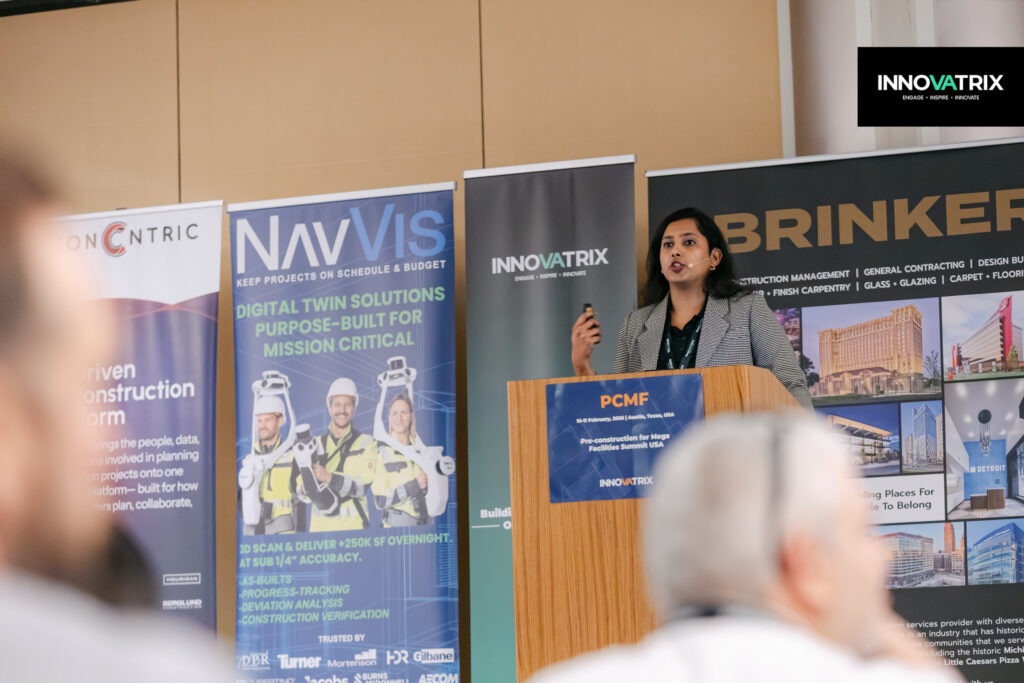
The Present and Future of Developing Integrated Cost & Schedule BIM
Damian Hamielec, Principal Consultant at Scheduling Simplified
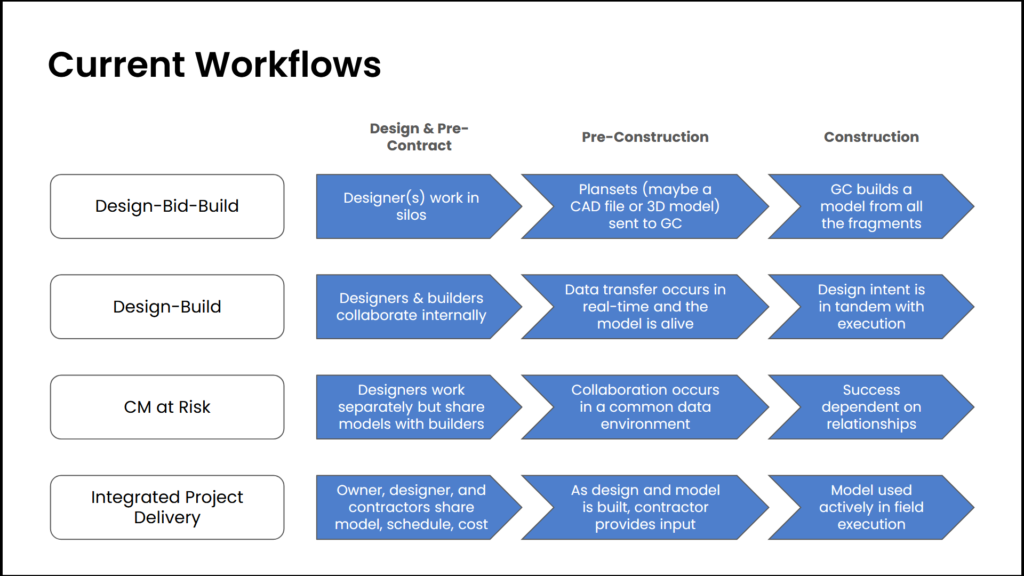
Damian examined the current and future development of integrated cost and schedule BIM, focusing on how model geometry, work breakdown structures, sequencing, estimating, resources and productivity data can be combined to improve project delivery.
He explained how different Levels of Development support increasingly sophisticated applications. LOD 300 enables accurate quantities, work-density analysis, trade-stacking avoidance and sequence validation; LOD 350 supports precise estimating and clash detection; and LOD 400 provides the detailed geometry required for fabrication, crew sequencing and shop-drawing reviews. However, developing detailed models remains expensive and requires significant collaboration.
Damian identified several limitations in the current ecosystem, including delivery methods that fail to incentivise unified models, owners that do not require BIM, steep learning curves and the lack of dynamic environments where architects, engineers and construction teams can collaborate in real time.
Future tools should therefore offer intuitive interfaces, guided workflows, integrated databases, construction-friendly concurrent development, federated models, multiplayer collaboration and precise quantity take-offs. He noted that government agencies, technology companies and forward-thinking developers are increasingly pushing contractors towards stronger BIM capabilities, while construction is becoming more data-driven and AR and VR technologies become more accessible.
Looking ahead, Damian considered how integrated 4D and 5D BIM could evolve into more connected, collaborative platforms that fundamentally reshape contracts, documentation and design workflows.
When Projects Become Visible
Tomislav Žigo, CEO of BEXEL USA
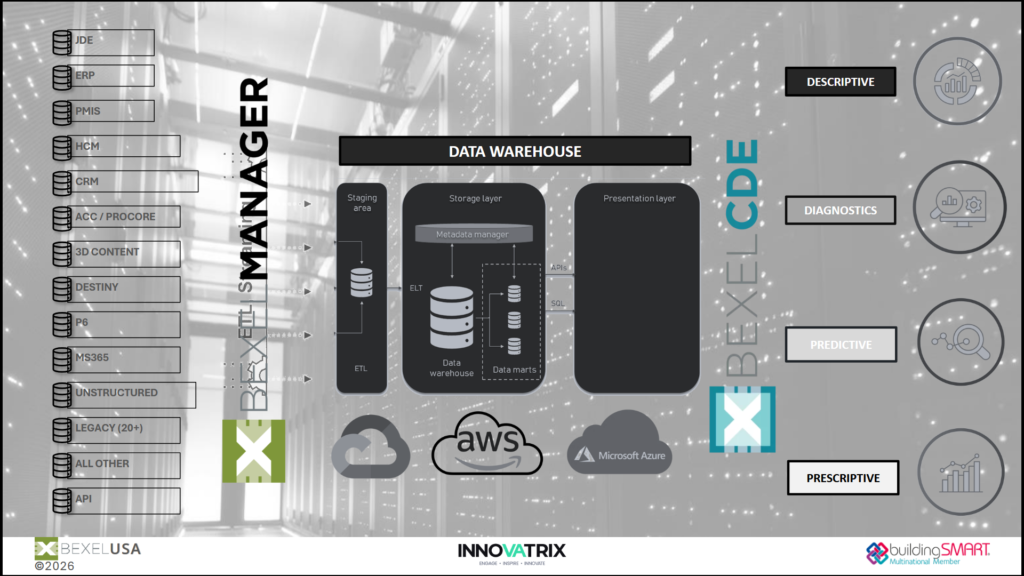
Tomislav explored how making construction projects visible through integrated digital information can surface risk earlier and shift decision-making from hindsight to evidence. He highlighted the growing scale and complexity of construction, alongside rising material and equipment costs, labour shortages, schedule delays and budget overruns, reinforcing the need for better project intelligence.
He argued that fragmented information creates significant waste, with project teams losing time searching for data while much collected information remains unused. A fit-for-purpose data environment should integrate BIM, schedules, costs and field information while securely preserving both explicit knowledge, such as documents and procedures, and tacit knowledge, including expertise, experience and observations.
Tomislav presented situational awareness as the combination of project context, risks, teams, resources, environment, processes, technology and AI. Integrated schedule and cost transparency can expose hidden delays, validate planning logic, identify missing tasks or model elements, and improve coordination. Four-dimensional planning can also reduce resource conflicts, while takt planning helps trades coordinate consistently.
He emphasised just-in-time analytics, schedule validation, risk-based safety planning and real-time visibility for stakeholders. Ultimately, greater process visibility enables data-centric project management, earlier risk mitigation, improved collaboration and more credible decisions throughout the project lifecycle, while preserving knowledge for future projects.
How VDC and BIM Are Shaping the Future of Project Delivery
Greg Smith, Director of BIM/VDC at Yates Construction
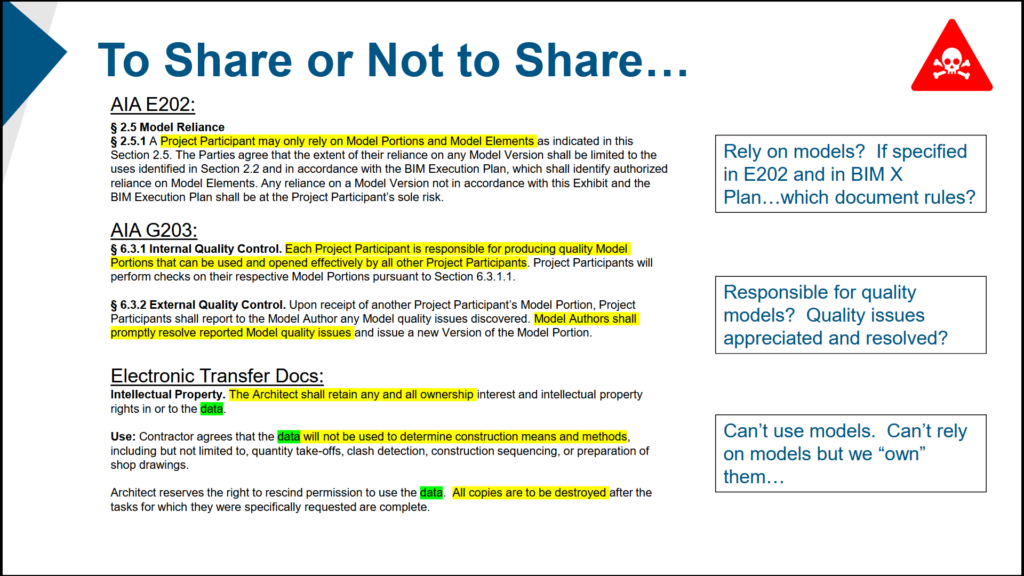
Greg explained that the purpose of VDC is to deliver the right information to the right person, at the right time and for the right task, while making it as accessible as possible. BIM plays a central role by improving coordination, identifying clashes early and reducing costly rework during fabrication and construction.
He highlighted the importance of structured MEP coordination and stratification within BIM. A defined sequence can coordinate underground utilities first, followed by MEP risers, gravity pipe and fire protection mains, then mechanical ductwork and electrical cable trays, fire protection branch lines and electrical conduit. This systematic approach helps trades work from a coordinated model and reduces conflicts.
Standardising BIM models across trades is equally important for collaboration. Greg emphasised the value of a clear BIM Execution Plan that defines how information is shared, where data is stored, file-naming conventions, model origins and required processes. Without standardisation, software acquisition, training requirements, compatibility issues and process-related schedule delays can undermine project performance.
He also discussed integrated BIM environments as a means of accelerating decision-making, including collaborative estimating. Ultimately, effective VDC depends not simply on technology, but on consistent processes, standards and behaviours that enable teams to use shared information efficiently.
Modernizing construction deliverables: reduce costs & increase deliverable accuracy
Kevin Bromenshenk, VDC Director at Flintco, LLC
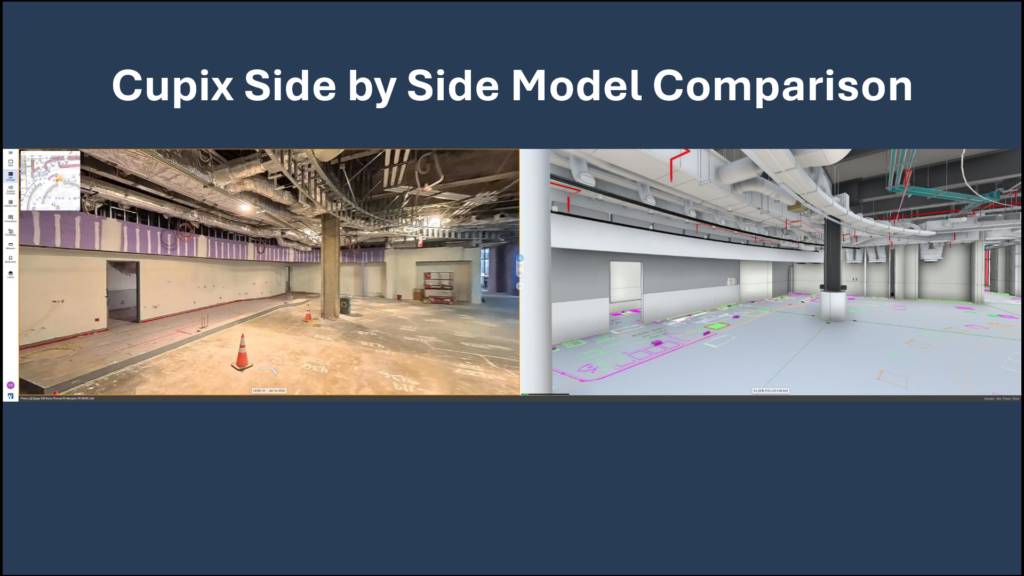
Kevin argued that construction specifications often reflect outdated workflows, requiring multiple sets of static paper or PDF drawings despite modern BIM and field technologies. Contract drawings, shop drawings, coordination drawings, as-builts and record drawings can duplicate effort, increase costs and introduce inaccuracies when teams are already coordinating through dynamic 3D models.
He highlighted coordinated shop drawings as an opportunity to combine traditionally separate shop and coordination drawing sets, reducing duplication while retaining the information required for fabrication and installation. Similarly, modern digital records can replace redundant as-built documentation, with BIM models, laser scans and reality capture providing more accurate and accessible records of installed conditions.
Kevin emphasised that BIM-driven deliverables offer superior quality, faster closeout and better coordination when information is centralised, current and accessible. Digital solutions can include updated and hyperlinked contract drawings, coordinated shop drawings, native and coordination models, laser scans and reality-capture platforms.
Early alignment is essential. Project teams should agree deliverable standards within the BIM Execution Plan, define modelling requirements, formats and accuracy levels, and establish how design changes will be incorporated. Clear agreements can prevent disputes, simplify closeout and reduce unnecessary costs.
He encouraged owners and preconstruction teams to challenge redundant specification requirements and explain modern alternatives early, ensuring technology is used to deliver greater value rather than simply adding another layer of documentation.
Data Centers & Mega Facilities: New Opportunities … and New Challenges
Jeevan Kalanithi, CEO of OpenSpace

Jeevan emphasised that speed and accuracy are both critical to data centre and mega-facility delivery because projects generate no return until they are commissioned. Their complexity magnifies the impact of small misses, while labour shortages limit the ability to resolve problems simply by adding more people. Teams therefore need fast, accurate visibility to protect schedules, revenue and market position.
He highlighted preconstruction as the point where project outcomes are largely established, with earlier decisions generally being cheaper to change. However, construction can drift from preconstruction assumptions, creating a significant visibility gap. Traditional progress reports, manual site walks, isolated photographs and verbal updates are often delayed, disconnected from schedules and BIM, and difficult to verify.
Jeevan presented visual intelligence as a way to close this gap. AI-supported progress tracking can provide reliable, comprehensive visibility of work in place, support payment verification, identify schedule risks early and automate reporting, freeing teams to focus on execution.
For mega facilities, an integrated visual record can serve as a shared source of truth from preconstruction through commissioning. Combining visual intelligence with ERP and project management systems creates a connected technology ecosystem, enabling owners, contractors and trades to work from the same reality. This supports faster decisions, proactive risk management, reduced rework and accelerated delivery without compromising accuracy.
Using AI & data analytics to improve estimating and scheduling
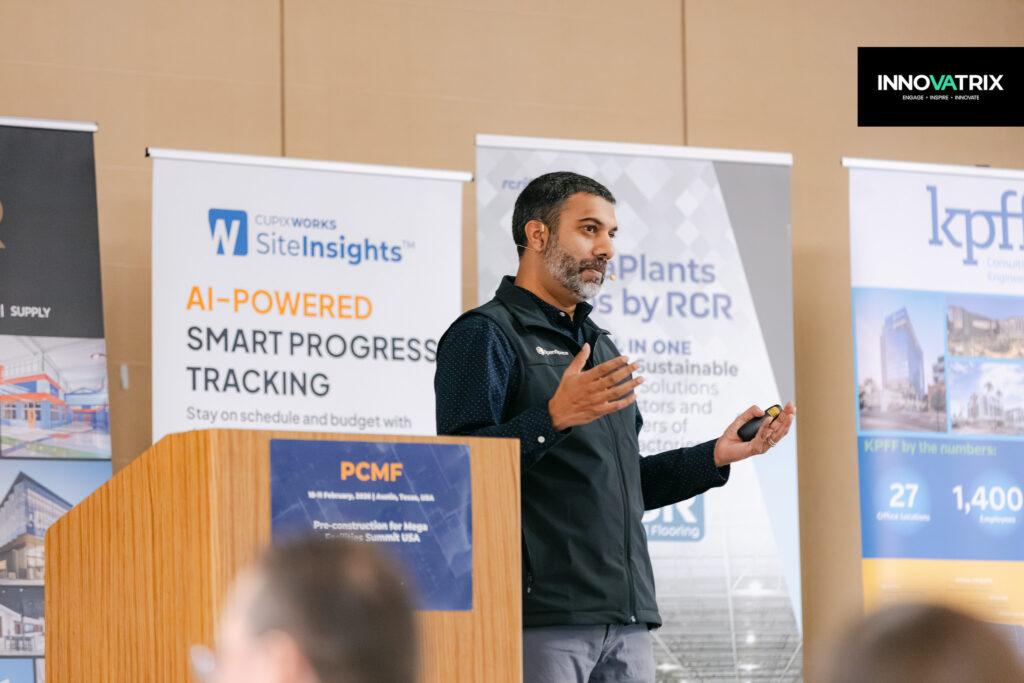
Archana Misra, AI Practice Director, Information Technology at Jacobs

Archana examined how AI and data analytics can modernise construction estimating and scheduling, addressing an industry that remains highly fragmented and reliant on manual processes. She highlighted that projects are becoming larger and more interconnected, while cost and schedule overruns remain common and traditional tools struggle to keep pace with dynamic project conditions.
AI-enabled estimating and scheduling can transform large volumes of historical and project data into continuous, predictive insights. Rather than replacing estimators and schedulers, AI augments their judgement by recognising patterns across thousands of projects, normalising early estimates, continuously refining forecasts and identifying schedule risks before they materialise. It can predict schedule slippage, cost growth, declining labour productivity, supplier reliability and changes in order volumes.
Archana stressed that successful AI adoption depends on embedding it into existing workflows rather than adding another disconnected tool. Organisations need consistent data structures, centralised historical information, standardised WBS and cost codes, and effective change management. Targeted pilots can demonstrate measurable value before wider deployment.
For owners, contractors and controls teams, these capabilities can improve capital planning, strengthen bids, reduce execution surprises and shift project controls from reporting towards forecasting. Looking ahead, AI could support predictive maintenance, autonomous construction, smart materials management, enhanced safety, real-time site optimisation, inventory management and AI-driven digital twins.
The torrid pace continues – State of the Market 2026
Sean Farney, Vice President, Data Center Strategy Americas at JLL

Sean outlined a period of unprecedented expansion in the global data centre sector, driven by cloud adoption and the rapid acceleration of artificial intelligence.
He highlighted that nearly 100 GW of new capacity is expected to be added between 2026 and 2030, effectively doubling global capacity and fuelling a projected 14% CAGR. This growth is underpinned by a major infrastructure investment cycle, with up to $3 trillion required by 2030. The Americas are leading this expansion, although strong growth is also expected across EMEA and APAC.
AI is set to fundamentally reshape demand, with workloads potentially accounting for half of all data centre activity by 2030. While training currently dominates, inference is expected to overtake by 2027, driving more geographically distributed deployments to reduce latency.
However, supply-side constraints remain significant. Grid connection delays—often exceeding four years—are pushing operators towards self-generation, power purchase agreements, and private energy solutions. Equipment lead times remain elevated, prompting early procurement and inventory strategies.
Rising demand and constrained supply are also driving costs, with construction expenses increasing by around 7% annually. Speed-to-power was identified as a critical success factor, shaping both site selection and investment decisions.

Data Intelligence in Action: Smarter Design, Safer Projects, Faster Delivery
Chris Seferlis, Director of Technology Strategy at Microsoft

Chris argued that late discovery is one of the most expensive failure modes in major capital projects, with small errors accumulating until correction becomes costly or impossible. He highlighted that design coordination issues account for a significant share of construction rework, demonstrating how the timing of discovery can determine both cost and available solutions.
Traditional dashboards primarily explain what has already happened, but by the time a KPI turns red, the decision window may have closed. Chris advocated moving from descriptive reporting towards predictive and prescriptive analytics that identify emerging risks earlier and recommend appropriate action. This principle also applies to scheduling: rather than focusing only on the critical path, teams should assess which activities are most likely to become critical and evaluate multiple potential futures.
AI can improve decision timing without replacing human judgement. It can continuously monitor large datasets and identify patterns, allowing teams to focus their expertise on the most significant issues, stakeholder trade-offs and final decisions. Earlier visibility also creates a shared economic advantage by reducing capital risk for owners, margin erosion for contractors and adversarial relationships between stakeholders.
Chris recommended starting with timing rather than technology: identify decisions that become expensive when delayed, trace their preceding signals, build systems to surface those signals earlier, and scale proven approaches gradually. The objective is not perfect prediction, but seeing problems while there is still time to act.
Where speed is won and lost between design and delivery
Angel Say, CEO of Resolve
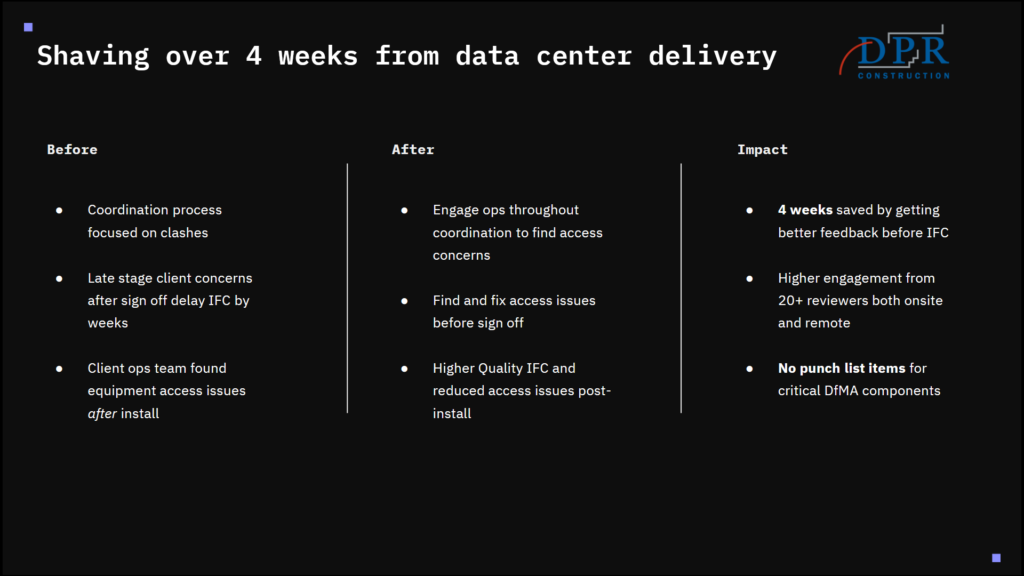
Angel examined why speed is often lost between design and construction, arguing that familiar issues such as labour shortages, slow procurement, limited prefabrication, poor scheduling and weak progress tracking are only part of the problem. Significant delays also originate before construction begins, when designs are not truly ready for issue for construction, sign-offs lack confidence, coordination is deferred to the field and operations and maintenance requirements are validated too late.
She highlighted the growing design-review burden, with teams expected to assess thousands of drawing sheets without sufficient time or effective tools. Even if field construction could be accelerated dramatically, unresolved design issues would continue to create rework. The key opportunity is therefore to close the design-delivery gap rather than simply trying to build faster.
Angel encouraged mission-critical teams to move beyond incremental improvements and technology-focused solutions. Instead, organisations should examine how stakeholders work together, redesign processes around collaboration and identify hidden bottlenecks.
Effective reviews can accelerate delivery by catching mistakes earlier, engaging internal and external partners sooner, and making review processes virtual, continuous and increasingly automated. She encouraged teams to identify their blind spots, determine which stakeholders are being engaged too late, and explore asynchronous review methods that can ultimately support automation. The goal is simple: design the right things first, then build them quickly and accurately.
Improving reliability in data centers by applying automation and controls from design to operation
Manuel Gómez, Controls & Automation Delivery Manager at Equinix
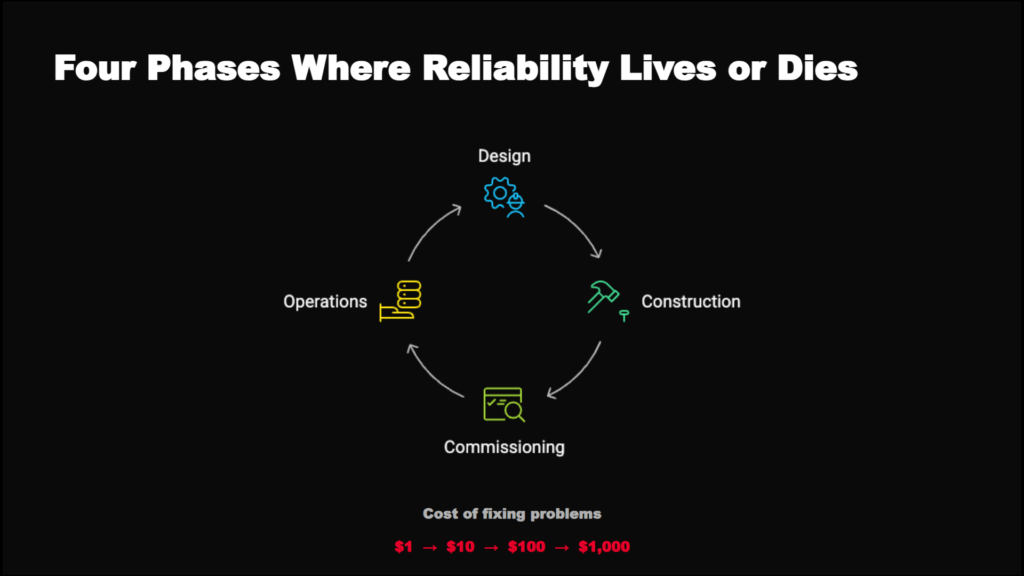
Manuel focused on the principle that reliability should be designed into data centres rather than tested after systems are built. He argued that silent assumptions can create significant failures, particularly as system complexity increases. Simplifying designs and challenging unnecessary requirements can therefore improve reliability by reducing the number of components and interactions that may fail under abnormal conditions.
He introduced the concept of the digital twin as a “flight simulator” for a facility, enabling teams to safely simulate failures, operational sequences and load transitions before they occur in the physical environment. By identifying weaknesses earlier, digital twins can increase confidence and potentially reduce unplanned downtime.
Manuel also stressed that reliability is ultimately a human responsibility because data-centre outages can affect critical medical, financial and AI workloads. Automation should therefore support people rather than simply add technological complexity.
He encouraged teams to ask in every project meeting: “What are we assuming that automation will expose later?” This question can reveal hidden risks before they become operational problems. His proposed lifecycle approach—design, simplify, automate and validate—integrates reliability considerations from initial design through operation. By challenging assumptions, reducing unnecessary complexity and validating automated systems digitally, teams can make reliability effectively invisible by preventing failures before they occur.
Durable Sustainable & Robot-ready Slabs
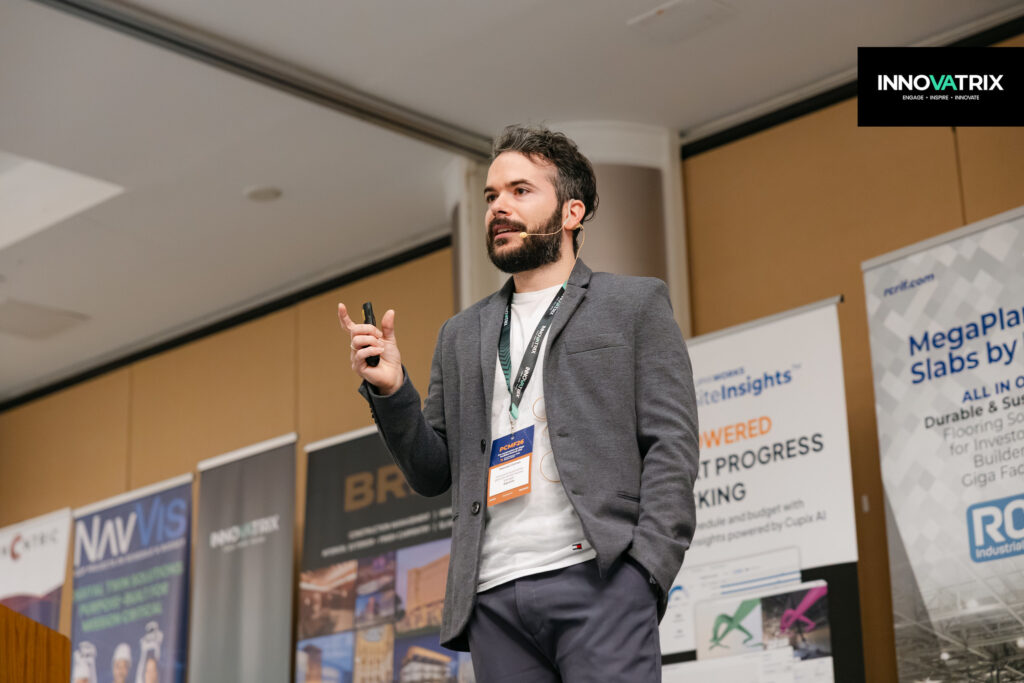
Christophe Cortinovis, Chief Operating Officer at RCR Industrial Flooring
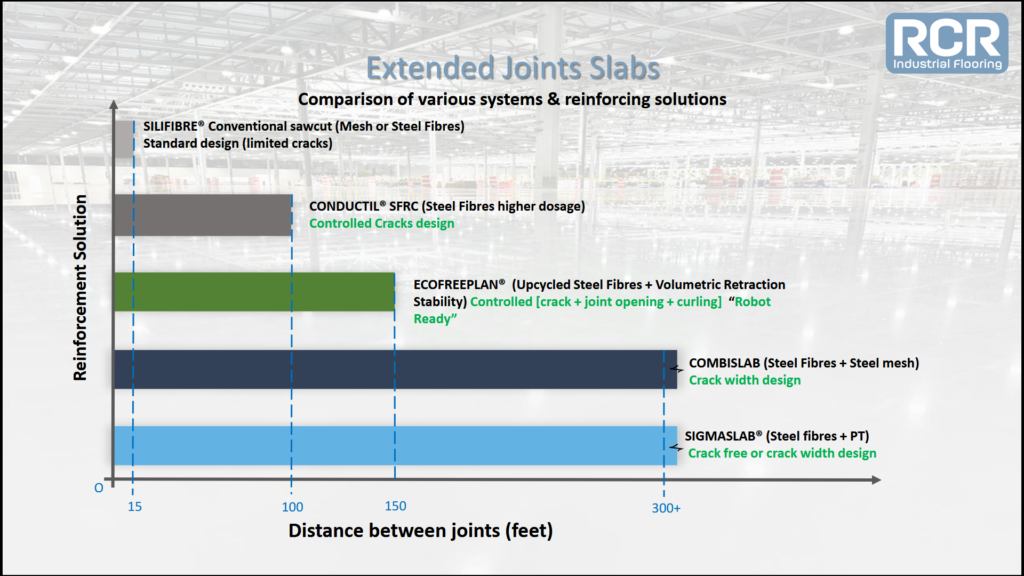
Christophe highlighted the importance of preconstruction engineering in creating durable, sustainable and robot-ready industrial floors. He explained that slab failures such as curling, cracking, joint opening and inadequate flatness can disrupt automated operations, particularly in facilities dependent on AGVs, AMRs and other high-speed material-handling systems.
Traditional slabs can contain extensive joint networks, with as much as 35 miles of joints in a 1-million-square-foot building. These joints can damage forklift wheels, disrupt automated vehicles and create ongoing maintenance and repair requirements. Christophe presented engineered slab systems that consider subbase conditions and loading requirements while using approaches such as steel-fibre reinforcement, post-tensioning and hybrid designs, supported by finite-element modelling.
Reducing the number of joints can improve durability, lower maintenance and repair costs, reduce equipment wear and business disruption, and allow automated systems to operate at higher speeds. This can also improve workplace conditions by reducing vibration, fatigue and stress.
Surface regularity is equally important. Poor flatness and levelness can affect AGV traction, positioning accuracy, driving speed and product safety, while excessive vibration can contribute to equipment damage and downtime. High-definition mapping can be used to survey, analyse, correct and certify surfaces.
For battery, cleanroom and dryroom applications, specialised coatings can provide low contamination, low emissions, pore-free and jointless surfaces, with conductive or electrostatic properties to support product quality, reliability and safety.
VDC in pre-construction to ensure cost, schedule & constructability certainty
Kevin Wanner, VDC Senior Manager at Turner Construction Company
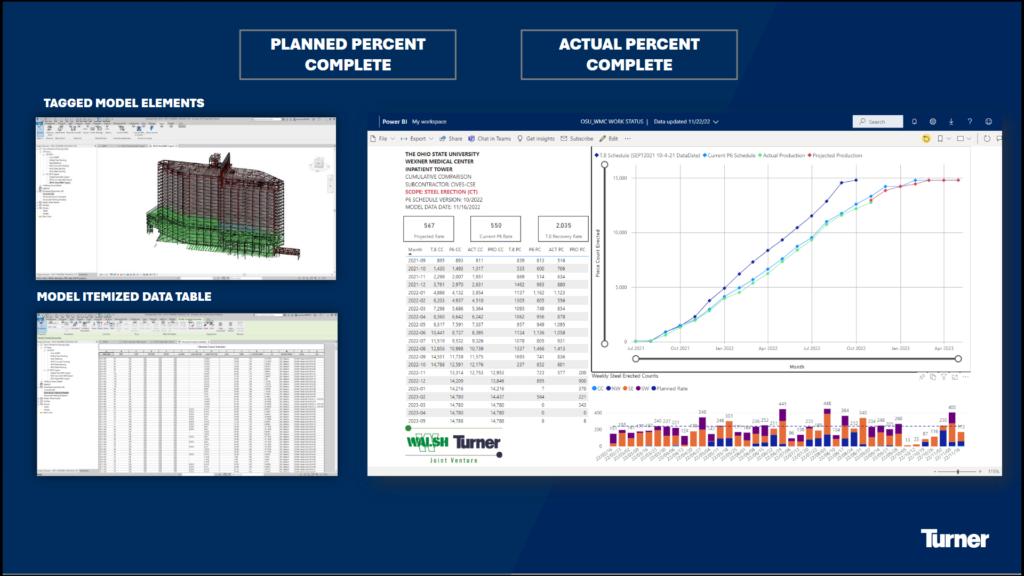
Brian highlighted how outdated reality-capture methods can create significant risks during mega-project preconstruction. Disorganised photographs, manual folder structures, limited collaboration, inefficient capture processes and the absence of comparison tools make information difficult to access, reduce repeatability and can result in missed milestones and incomplete site coverage.
He outlined how automated reality capture can improve cost and scope certainty. Centimetre-accurate earthwork quantities and cut/fill analysis can reduce budget volatility, while virtual site access gives trade partners greater visibility during tendering and helps clarify scope. Overlaying BIM models from platforms such as Revit or Navisworks onto captured site data can identify design-to-field deviations before mobilisation, reducing rework.
Brian also emphasised the value of creating a chronological, geolocated visual record of existing conditions. This can help protect against disputes involving adjacent property damage and utility strikes while providing a reliable record throughout project delivery.
He distinguished a construction-grade drone programme from basic aerial photography, stressing the need for survey coordinates, ground control points and design-file integration. Site logistics mapping can further support crane planning, delivery routes, traffic management and safety by combining maps with design overlays.
Ultimately, effective reality capture connects the physical site to design and planning information, enabling teams to identify unknowns earlier, improve collaboration and make more confident preconstruction decisions.
Cost control strategies built into large-scale project management processes
Dana A. Wells, Director of Pre-Construction of Peerless Construction Solutions
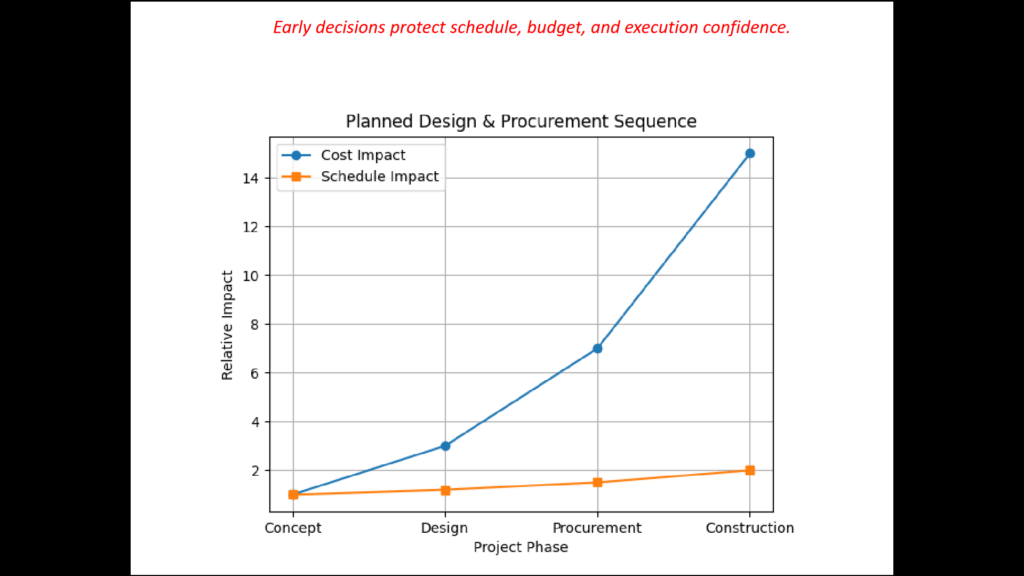
Dana argued that mega projects rarely fail because teams lack effort; instead, cost and schedule are often lost because leadership waits too long to make critical decisions. Delayed decisions, scope misalignment and unidentified or ignored risks can allow problems to become significantly more expensive before they are addressed.
He emphasised the importance of clear scope ownership, defined decision-making authority and early alignment. Cost certainty should be established early through integrated budgeting and rolling forecasts linked to actual project progress, ensuring scope, cost and schedule remain aligned throughout delivery.
Dana identified design lock as another critical leadership discipline. Locking design decisions forces risks into the open, improves cost predictability and allows execution to accelerate. Risk-based contingency planning should similarly identify risks early, assign ownership and provide realistic funding rather than relying on optimistic assumptions.
He distinguished management from leadership: management tracks costs, while leadership actively controls them through timely decisions and intervention. Early decisions are generally less costly and protect schedule, budget and execution confidence, whereas late decisions can create cascading impacts.
His central message was that successful cost control depends on disciplined leadership throughout the project lifecycle: lead earlier, decide faster and accept emerging realities sooner. This approach enables teams to address uncertainty while options remain available and prevents avoidable costs from becoming embedded in project delivery.
Integrated Hauling and Logistics Management for Equipment Deliveries in Mega Projects
Daniel Odion, Advisory Board Member of the American Society of Civil Engineers (ASCE) Central Ohio Chapter
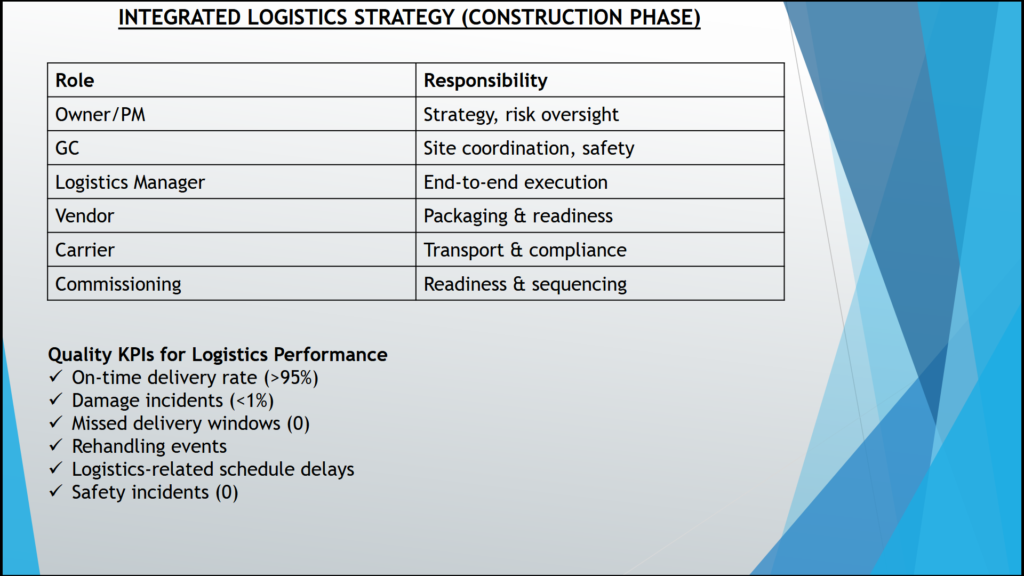
Daniel highlighted integrated hauling and logistics management as a critical component of schedule protection, safety and commissioning on mega projects. Large facilities often involve oversized, high-value and long-lead equipment arriving from multiple global sources, making poor logistics planning a potential cause of delays, congestion, damage, safety incidents and commissioning setbacks.
He emphasised that logistics planning should begin during the 30–60% design phase, identifying critical equipment, delivery windows, haul routes, permits, crane access, storage requirements and staging strategies. Vendor contracts should include logistics requirements, packaging and lifting information, delivery-readiness checks and shipping milestones. Qualified carriers, contingency routes and schedule buffers are also essential.
During construction, hauling schedules should be integrated with the master programme, planned backwards from required completion dates and organised around fixed delivery windows. Critical-path loads should be prioritised while accounting for complete load-cycle times and contingency for weather or equipment breakdowns.
Daniel stressed that logistics must also support commissioning by sequencing equipment according to readiness, coordinating energisation windows and avoiding storage conditions that could affect warranties. Safety requires delivery-specific hazard analyses, traffic plans, exclusion zones and lift plans.
Digital tools including GPS tracking, dispatch systems, mobile delivery applications and BIM integration can improve visibility and coordination. He concluded that disciplined, integrated logistics reduces downtime and transport costs, improves safety and protects both construction schedules and commissioning milestones.
Sponsors
The Pre-construction for Mega Facilities Summit USA was supported by a wide range of sponsors who brought their teams to our exhibition hall, and Innovatrix would like to thank them again for their support.
ConCntric, NavVis, Bexel USA, OpenSpace, DroneDeploy, Brinker, Dusty Robotics, Cupix, Resolve, RCR Industrial, FARO, Data Center Construction, Aurigo, Highwire, Perry Weather, Pinnacle Infotech, KPFF, W.W. Gay, CORE and Peerless Construction.

If you want to attend our next mega construction summit and have the opportunity to hear presentations like these and many more, join us for the 2nd Constructing Mega Facilities Summit: Advances in Planning, Design and Engineering. To expand your professional network, collaborate with peers, and gain forward-thinking insights into the planning, design, and engineering of large-scale industrial facilities, register for the 2nd Constructing Mega Facilities Summit!
For more information, visit our website or email us at info@innovatrix.eu for the event agenda. Visit our LinkedIn to stay up to date on our latest speaker announcements and event news.