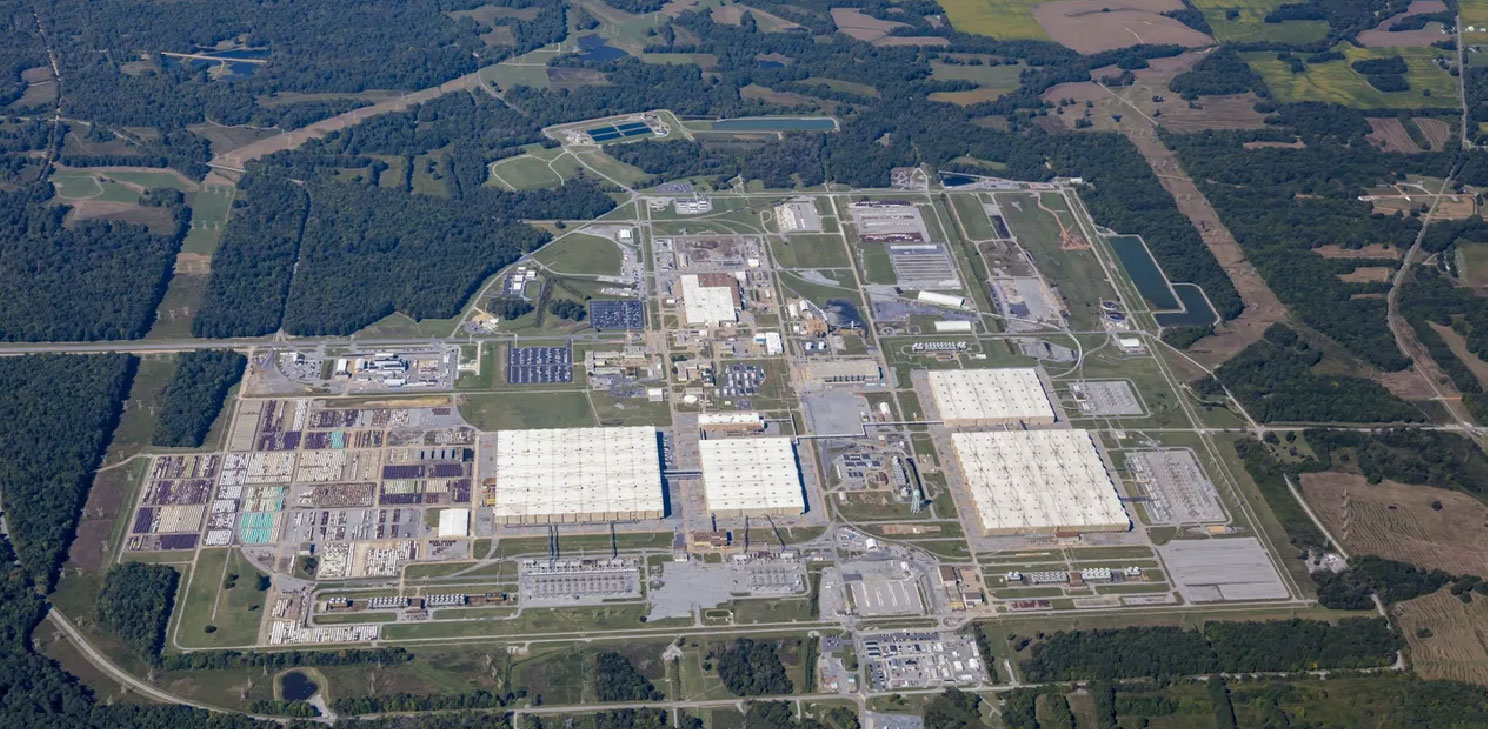
Brookfield and NextEra Energy plan to transform part of the US Department of Energy’s former Paducah Gaseous Diffusion Plant in Kentucky into one of the nation’s largest AI data center campuses, targeting more than 1.2 GW of compute capacity and dedicated on-site power generation built specifically for the project. The companies said the investment could total roughly $100 billion over time.
Announced on Wednesday by the Paducah American Energy Hub coalition, the plan positions Brookfield to develop and operate the campus while NextEra builds dedicated generation and storage adjacent to the site. The current concept calls for up to 2 GW of natural gas generation and up to 2.6 GW of battery energy storage, with the partners indicating the campus could support up to 1.8 GW of utility-delivered capacity by 2032.
The partnership also includes Big Rivers Electric Power Corporation, Jackson Purchase Energy Cooperative, and Paducah Power System.
The Department of Energy (DOE) selected Brookfield following its November 2025 Request for Offers to lease land and develop the campus at the Paducah site. DOE picked NextEra to build and own the dedicated generation resources. The project remains subject to negotiation and execution of definitive agreements, as well as regulatory approvals.
“Demand for critical infrastructure that accelerates innovation in the US and supports the economy will need to be met with capital, development capabilities, and additional power generation that benefits local communities,” Brookfield CEO Bruce Flatt said in a statement. “The Department of Energy’s Paducah Site will be the seed of our plan to invest $100 billion in AI infrastructure.”
NextEra Chairman, President, and CEO John Ketchum said the development is intended to demonstrate an approach for adding AI capacity without shifting power grid upgrade costs to existing customers. “This project is a proof point for how AI infrastructure should be built in America,” Ketchum said in a statement. “The data center will bring its own power, pay for its own power infrastructure, and create good-paying jobs for local workers.”
For hyperscale operators, the project underscores a broader shift toward treating power as part of the campus, not solely as an external utility dependency.
“The industry is moving toward a world where the largest data center campuses increasingly have to bring some combination of generation, storage, transmission funding, and load flexibility with them,” said Neil Osnato, founder of Persistence Analytics Group.
Osnato said the project’s dedicated generation model could shorten the path to power for hyperscale AI campuses while reducing the need to socialize infrastructure costs across existing utility customers. But he cautioned against interpreting the project’s announced generating resources as equivalent to firm capacity. “The first thing I would not do is add those resources together and call it 4.6 GW of equivalent firm generation,” he said. “A gigawatt of battery capacity is not the same thing as a gigawatt of continuously available generation.”
The critical questions, he added, are how much firm capacity the campus can sustain during stressed conditions and what support it will still require from the interconnected grid. “Bringing your own power is a major improvement,” Osnato said. “It is not the same as bringing your own grid.”
He added that planners will ultimately need to evaluate more than the project’s headline investment and nameplate capacity, including transmission requirements, fuel infrastructure, reserve obligations, battery operating assumptions, and whether incremental system costs remain appropriately assigned.
“Do not count dedicated megawatts by nameplate,” Osnato said. “Verify what they can actually deliver when the system is stressed.”
The former enrichment site offers transmission access, water infrastructure, fiber connectivity, roads, and large tracts of developable land – advantages that can accelerate timelines relative to greenfield locations. Under the proposed structure, Big Rivers Electric would provide wholesale service, Jackson Purchase Energy Cooperative would provide retail service, and Paducah Power System would serve as a community partner. The power service agreement will require approval from the Kentucky Public Service Commission.
The coalition estimates approximately 8,000 construction jobs and 600 permanent operations jobs. In announcing the plan, Energy Secretary Chris Wright characterized the project as a potential blueprint for future AI infrastructure development, emphasizing the goal of avoiding cost shifts to surrounding communities.
“It’s difficult to overestimate the importance of this project,” Wright said in the announcement. “The planning and investment by NextEra Energy and Brookfield provide a crucial roadmap for future projects in the United States by revealing the ability to build world-leading infrastructure without passing costs on to surrounding communities.”
The announcement did not identify an anchor AI customer or a construction start date.
To find out more about the latest industry updates and innovations in data center construction, meet with solution providers and hear talks from expert speakers, attend the 8th Powering Next-Gen Data Centers USA: Accelerating Time-to-Power, Grid Capacity & Energy Infrastructure, taking place December 15-16, 2026, in Dallas, Texas, USA..
For more information, click here or email us at info@innovatrix.eu for the event agenda. Visit our LinkedIn to stay up to date on our latest speaker announcements and event news.
Source: